
This document introduces the features and characteristics of the NA555, NE555, SA555 and SE555 four precision timers, including the timing range, duty cycle, operating mode and output current.
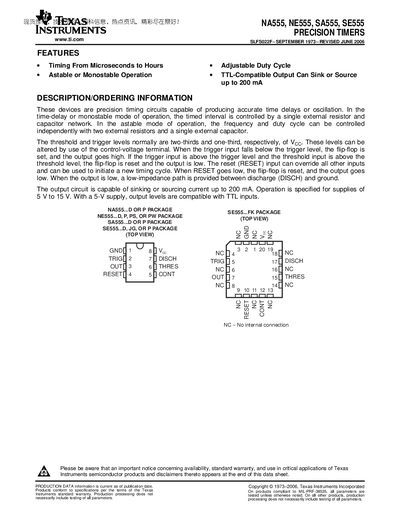
The document provides detailed specifications for the NA555, NE555, SA555 and SE555 precision timer integrated circuits. It covers features, ordering information, electrical characteristics, absolute maximum ratings, and typical performance curves.
Key information includes supply voltage ranges, output current capability, temperature limits, and the various package options available for each part number. The sheet also contains mechanical drawing data and legal notices from Texas Instruments.
| Supply voltage range | 5 V to 15 V |
|---|---|
| Output current capability | up to 200 mA |
| Maximum supply voltage (VCC) | 18 V |
| Low temperature limit | -40 °C |
| High temperature limit | 125 °C |
| NE555 package types | D, P, PS, PW |
The timers operate from 5 V up to 15 V.
It can source or sink up to 200 mA.
The NE555 is offered in D, P, PS and PW packages.
The absolute maximum VCC rating is 18 V.