
The ADM3493 is a low power, differential line transceiver designed to operate using a single 3.3 V power supply. It supports EIA RS-422 and RS-485 standards, data rate is 250 kbps, and supports up to 256 transceivers connected.
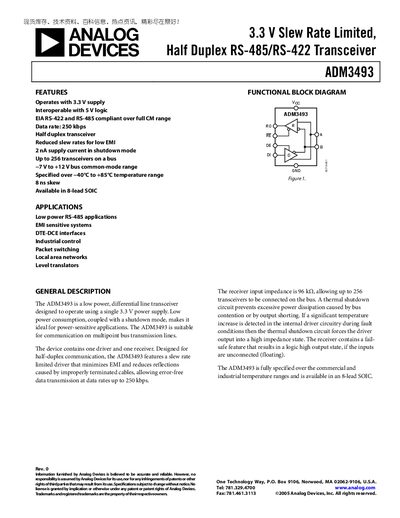
The ADM3493 is a low‑power differential line transceiver designed for half‑duplex RS‑485/RS‑422 communication using a single 3.3 V supply. It features a slew‑rate‑limited driver to reduce EMI and reflections, and includes a shutdown mode that draws only 2 nA.
Key features include operation over a –40 °C to +85 °C temperature range, up to 256 transceivers on a bus, data rates up to 250 kbps, and an 8‑lead SOIC package. The device provides driver output protection and a thermal shutdown circuit for fault conditions.
| Supply Current (typical) | 1.1–2.2 mA |
|---|---|
| Shutdown Mode Current | 2 nA |
| Maximum Bus Transceivers | 256 |
| Data Rate | 250 kbps |
| Operating Temperature Range | –40 °C to +85 °C |
| Package | 8‑lead SOIC |
| Driver Output Delay (typical) | 900 ns |
| Propagation Delay (typical) | 1000 ns |
It operates with a 3.3 V supply.
Up to 256 transceivers can be connected on the bus.
The device draws only about 2 nA in shutdown mode.
The ADM3493 supports data rates up to 250 kbps.