
This is a 5V low-power, slew-rate-limited RS-485/RS-422 transceiver with the following features: Complies with EIA RS-485/RS-422 standards, data rates up to 250kbps, slew-rate limited design for low EMI, supply current of only 100nA in shutdown mode, low power consumption (120µA), up to 32 transceivers can be connected on one bus, outputs high-z when disabled or powered off, -7V to +12V bus common-mode range, thermal shutdown and short-circuit protection, pin-compatible with MAX483, -40°C to +85°C temperature range, 8-lead SOIC package.
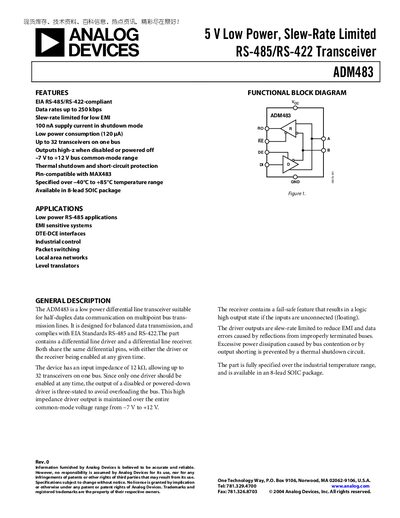
The ADM483 is a low‑power differential line transceiver designed for half‑duplex data communication on multipoint bus systems. It complies with EIA RS‑485 and RS‑422 standards and features slew‑rate limiting to reduce EMI.
Key features include a common‑mode voltage range of –7 V to +12 V, up to 32 transceivers on a single bus, and a shutdown supply current of only 0.1 µA. The device is supplied in an 8‑lead SOIC package and operates from –40 °C to +85 °C.
| Maximum Data Rate | 250 kbps |
|---|---|
| Operating Temperature Range | –40 °C to +85 °C |
| Shutdown Supply Current | 0.1 µA |
| Common‑Mode Voltage Range | –7 V to +12 V |
The device operates over a common‑mode voltage range of –7 V to +12 V.
The ADM483 supports a maximum data rate of 250 kbps.