
The EL1508 is a differential DSL line driver from Philips designed to drive full rate ADSL signals in both CO and CPE applications at very low power dissipation. Its 450mA high drive capability makes it ideal for both CAP and DMT designs. It contains two wideband, high-voltage, current mode feedback amplifiers with a number of power dissipation reduction features. These drivers achieve an MTPR distortion measurement of better than 70dB, while consuming typically 6mA of total supply current. This supply current can be set using a resistor on the IADJ pin. Two other pins (C0 and C1) can also be used to adjust supply current to one of four pre-set modes (full-IS, 2/3-IS, 1/3-IS, and full power-down). The EL1508 operates on ±5V to ±12V supplies and retains its bandwidth and linearity over the complete supply range. The device is supplied in a thermally-enhanced 20 Ld SOIC (0.300”), a thermally-enhanced 16 Ld SOIC (0.150”), and the small footprint (4x5mm) 24 Ld QFN packages. The EL1508 is specified for operation over the full -40°C to +85°C temperature range.
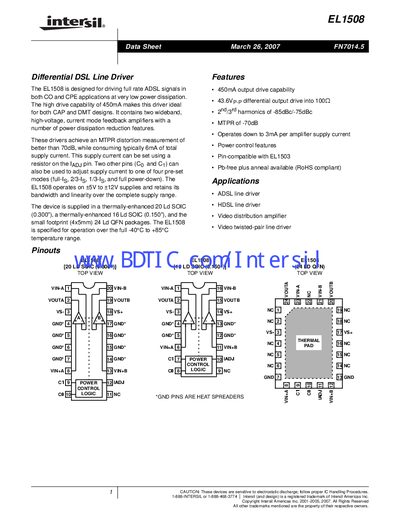
The EL1508 is a differential DSL line driver designed for ADSL and HDSL applications. It offers a high‑drive capability of 450 mA, low distortion (MTPR ≈ ‑70 dB) and operates from +5 V to +12 V while maintaining performance over a wide temperature range.
The document includes electrical specifications, absolute maximum ratings, pin‑out tables, typical performance curves, and detailed package drawings for the 16‑lead SOIC, 20‑lead SOIC and 24‑lead QFN options. Ordering information and RoHS compliance notes are also provided.
| Output drive capability | 450 mA |
|---|---|
| Differential output voltage | 43.6 V p‑p into 100 Ω |
| MTPR distortion | -70 dB |
| Supply voltage range | +5 V to +12 V |
| Operating temperature range | -40 °C to +85 °C |
| Typical supply current | 6 mA |
The EL1508 can be powered from +5 V up to +12 V.
Each driver can deliver up to 450 mA of output current.
Yes, the devices are sensitive to electrostatic discharge and must be handled with proper IC handling procedures.