
The ISL22429 is a dual digitally controlled potentiometer with features such as low noise, low power, SPI bus, 128 taps, and wiper only.
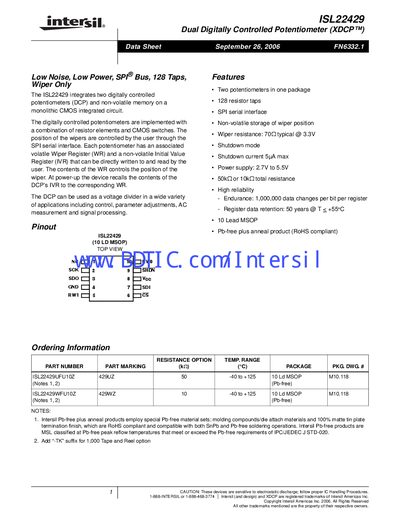
The ISL22429 integrates two digitally controlled potentiometers with 128 resistor taps each and non‑volatile memory on a CMOS IC. The wiper positions are set via an SPI serial interface and can be retained after power‑down using the built‑in non‑volatile registers.
The document includes detailed pin descriptions, absolute maximum ratings, recommended operating conditions, analog and operating specifications, timing diagrams, typical performance curves, and package dimensions for the 10‑lead MSOP version.
| Number of potentiometers | 2 |
|---|---|
| Resistor taps per potentiometer | 128 |
| Supply voltage range | 2.7 V to 5.5 V |
| Wiper resistance (typical) | 700 Ω @ 3.3 V |
| Shutdown current | 54 µA max |
| Endurance (data changes) | 1,000,000 cycles per bit per register |
| Data retention | 50 years @ ≤ +55 °C |
The device is controlled through an SPI serial interface.
Each potentiometer provides 128 resistor taps.
The shutdown current is specified as 54 µA max.
Typical wiper resistance is 700 Ω when powered at 3.3 V.