
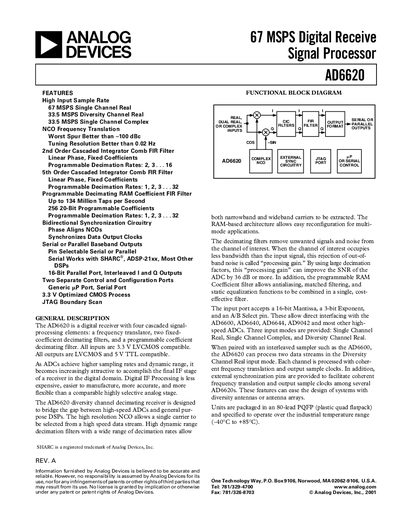
The AD6620 is a high‑speed digital receiver that combines a frequency translator, two fixed‑coefficient cascaded integrator‑comb (CIC) filters, and a programmable RAM‑coefficient FIR filter. It accepts 3.3 V LVCMOS inputs and provides both LVCMOS and TTL‑compatible outputs.
The device is offered in an 80‑lead PQFP package and operates over an industrial temperature range (‑40 °C to +85 °C). It supports multiple input modes, serial or parallel data interfaces, and includes JTAG boundary‑scan for testing.
| Supply Voltage (VDD) | 3.0 V – 3.6 V |
|---|---|
| Ambient Temperature Range | -40 °C – +85 °C |
| Logic Input "1" Voltage | 2.0 VDD + 0.3 V |
| Logic Output "1" Voltage (0.5 mA) | 2.4 VDD - 0.2 V |
| IDD at 20 MHz | 52 mA |
| IDD at 65 MHz | 167 – 227 mA |
| Power Dissipation at 20 MHz | 170 mW |
| Power Dissipation at 65 MHz | 550 – 750 mW |
| Maximum RAM FIR Filter Taps | 256 |
The AD6620 operates from a supply voltage of 3.0 V to 3.6 V.
It can operate from –40 °C up to +85 °C.
The RAM coefficient FIR filter can hold up to 256 taps.
At 65 MHz the device draws between 167 mA and 227 mA.