
The ADM485 is a differential line transceiver suitable for high speed bidirectional data communication on multipoint bus transmission lines. It is designed for balanced data transmission and features high speed, low power BiCMOS technology.
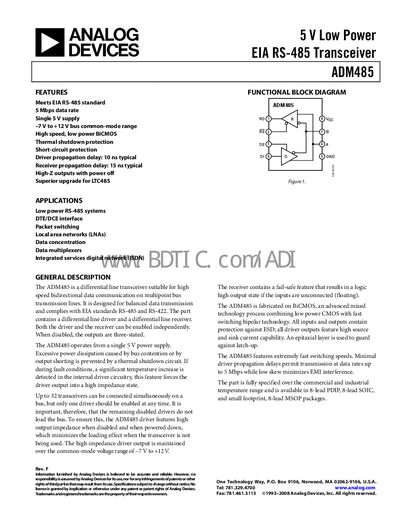
The ADM485 is a differential line transceiver designed for high‑speed bidirectional data communication on multipoint bus lines. It complies with EIA RS‑485 and RS‑422 standards, operates from a single 5 V supply, and includes thermal shutdown and short‑circuit protection.
The device supports up to 32 transceivers on a bus, but only one driver may be enabled at a time. It is available in 8‑lead PDIP, SOIC, and MSOP packages and offers fast propagation delays, low‑skew, and high‑impedance disabled outputs.
| Driver propagation delay (typical) | 10 ns |
|---|---|
| Receiver propagation delay (typical) | 15 ns |
| Differential output voltage (Voo) | 5.0 V |
| Common‑mode output voltage (Voc) | 3 V |
It operates from a single 5 V power supply.
Up to 32 transceivers can be connected simultaneously, but only one driver should be enabled at a time.
The device has thermal shutdown protection and short‑circuit protection.
The driver delay is typically 10 ns and the receiver delay is typically 15 ns.