
The AD8112 is an audio/video crosspoint switch with a bandwidth of 60 MHz and a 16×8 configuration. It has a gain of +2 and is a low-cost, high-speed, nonblocking switch array. The switch array can be controlled through serial or parallel programming, and the serial data out allows daisy chaining control of multiple 16×8 arrays to create larger switch arrays. The output disable feature allows connection of multiple devices without loading the output bus. The AD8112 exhibits excellent audio and video performance, operates on ±5 V or ±12 V supplies, and has low supply current and wide bandwidth characteristics.
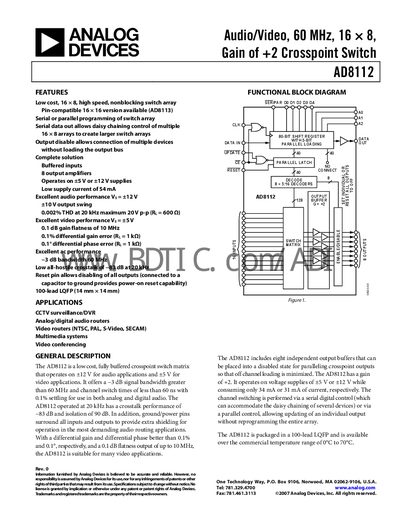
The AD8112 is a low cost, fully buffered crosspoint switch matrix that operates on +12 V for audio applications and +5 V for video applications. It offers a –3 dB signal bandwidth greater than 60 MHz and channel switch times of less than 60 ns with 0.1% settling for use in both analog and digital audio. The AD8112 operated at 20 kHz has a crosstalk performance of –83 dB and isolation of 90 dB. In addition, ground/power pins surround all inputs and outputs to provide extra shielding for operation in the most demanding audio routing applications. With a differential gain and differential phase better than 0.1% and 0.1°, respectively, and a 0.1 dB flatness output of up to 10 MHz, the AD8112 is suitable for many video applications.
The AD8112 includes eight independent output buffers that can be placed into a disabled state for paralleling crosspoint outputs so that off channel loading is minimized. The AD8112 has a gain of +2. It operates on voltage supplies of +5 V or +12 V while consuming only 34 mA or 31 mA of current, respectively. The channel switching is performed via a serial digital control (which can accommodate the daisy chaining of several devices) or via a parallel control, allowing updating of an individual output without reprogramming the entire array.
| Supply Current (outputs enabled, no load, Vs = +12 V) | 54 mA |
|---|---|
| Junction-to-ambient thermal impedance | 40°C/W |
| Maximum junction temperature | 150°C |
| Power Dissipation (outputs enabled, no load, Vs = +12 V) | 54 mA |
The supply current is 54 mA when the outputs are enabled and the supply voltage is +12 V.
The maximum junction temperature should not exceed 150°C.