
The document is the MAX® 160 Operation Manual, which describes the features and characteristics of Peavey products.
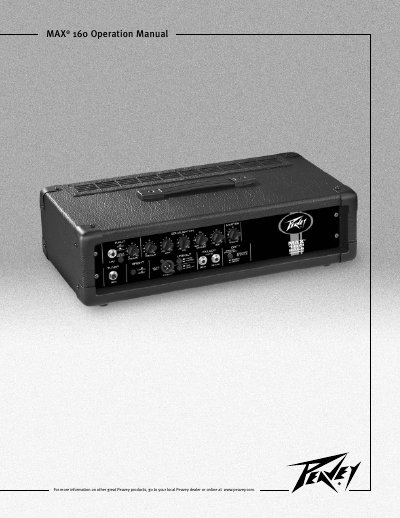
This manual explains how to safely install and operate the Peavey MAX®160 bass amplifier. It includes important safety warnings about dangerous voltages, proper grounding, and the need for qualified service personnel when repairs are required. The guide also covers power connections, fuse replacement, and recommended operating environments.
The document details each control and jack on the amp—pre‑gain, EQ knobs, volume, boost switches, tuner send, XLR output, and effects loop—plus the DDT speaker‑protection system. Technical specifications such as power output, input sensitivity, noise levels, and recommended settings are provided for optimal performance.
| Mains Voltage | 120 VAC 60 Hz (Fuse 5 A) / 230 VAC 50‑60 Hz (Fuse 3.5 A) / 100 VAC 50‑60 Hz (Fuse 6 A) |
|---|---|
| Power Consumption | 200 W |
| Minimum Load | 4 Ω |
| Power Output (4 Ω) | 160 W (25.3 V RMS) @ ≤0.1 % THD+N |
| Power Output (4 Ω, 1 % THD+N) | 175 W (26.46 V RMS) |
| System Noise | Typically greater than –85 dB |
| DDT Dynamic Range | +12 dB |
Connect the amp to a properly grounded AC supply of 120 VAC 60 Hz with a 5 A fuse, 230 VAC 50‑60 Hz with a 3.5 A fuse, or 100 VAC 50‑60 Hz with a 6 A fuse.
When the DDT switch is in the “in” position the compression is defeated; when active it protects the speakers and the LED indicates the DDT status.
Pre‑Gain = 5 (12 o’clock), Contour = 0 (fully CCW), Low = 0, Mid = 0, Mid Shift = 12 o’clock, High = 0, Master Volume = 5 (12 o’clock).