
The AD558 is a low cost 8-bit DAC from Analog Devices. It features a full microprocessor interface, single supply operation, fast settling time, low power consumption, internal precision bandgap reference and guaranteed monotonicity over temperature.
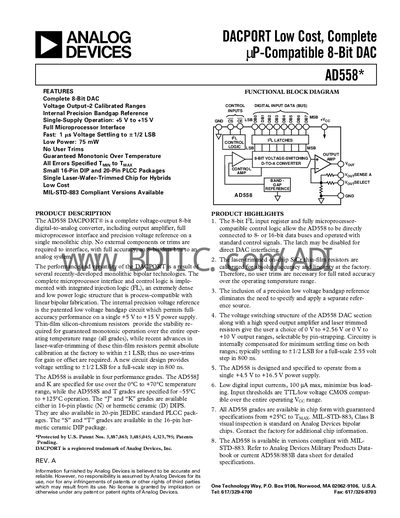
The AD558 DACPORT® is a complete 8‑bit digital‑to‑analog converter that integrates the output amplifier, precision bandgap reference and a microprocessor‑compatible control interface on a single monolithic chip. It operates from a single +4.5 V to +16.5 V supply, requires no external trims, and offers fast 800 ns settling for a full‑scale step.
The device is offered in several grades (J, K, S, T) and package types (16‑pin plastic or ceramic DIP, 20‑pin PLCC). Detailed specifications include 8‑bit resolution, selectable output ranges of 0‑2.56 V or 0‑10 V, low digital input current (≤100 µA), and power dissipation of 125 mW at 5 V. The datasheet also provides functional block diagrams, timing diagrams, grounding recommendations, and interfacing examples for common microprocessors.
| Settling time (0‑2.56 V range) | 800 ns (to +1/2 LSB) |
|---|
A supply voltage of at least +11.4 V is required for the 0‑10 V output range.
The device settles to +1/2 LSB for a full‑scale step in about 800 ns.