
16-bit, 4-Channel, 250 kSPS PulSAR® ADC Preliminary Technical Data AD7682
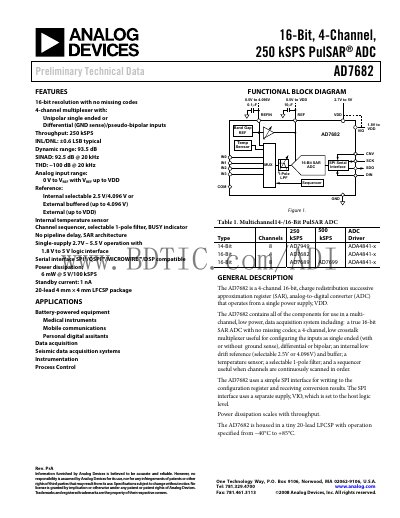
The AD7682 is a 4‑channel, 16‑bit successive‑approximation register (SAR) analog‑to‑digital converter that operates from a single 2.5 V‑5.5 V supply. It features a true 16‑bit resolution with no missing codes, selectable internal reference (2.5 V or 4.096 V), a low‑drift temperature sensor, and a 1‑pole filter. Throughput reaches 250 kSPS with a conversion time of 2.2 µs and power dissipation as low as 6 mW at 100 kSPS.
The device is supplied in a 20‑lead 4 mm × 4 mm LFCSP package and is rated for operation from –40 °C to +85 °C. Typical applications include battery‑powered equipment, medical instruments, mobile communications, data acquisition, seismic data acquisition systems, instrumentation, and process control.
| Resolution | 16 bits |
|---|---|
| Number of Channels | 4 |
| Maximum Throughput | 250 kSPS |
| Supply Voltage (VDD) | 2.5 V to 5.5 V |
| Standby Current | 1 nA |
| Package | 20‑lead LFCSP, 4 mm × 4 mm |
| Operating Temperature Range | -40 °C to +85 °C |
| Dynamic Range | 93.5 dB |
| Analog Input Range (Unipolar) | 0 to VREF |
The AD7682 can sample up to 250 kSPS when VDD is between 4.096 V and 5.5 V.
It is housed in a 20‑lead LFCSP package measuring 4 mm × 4 mm.
The device is specified for operation from –40 °C to +85 °C.