
The AD8211 is a high voltage, precision current shunt amplifier. It features a set gain of 20 V/V, with a typical ±0.5% gain error over the entire temperature range. The buffered output voltage directly in...
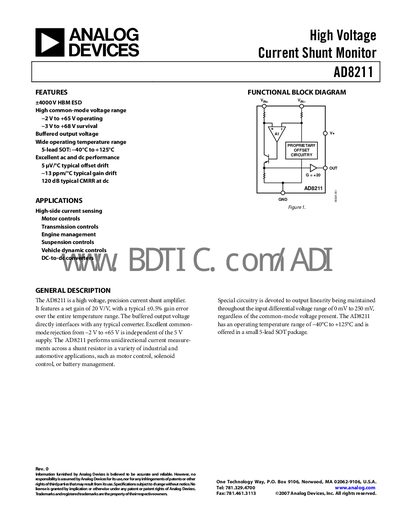
The AD8211 from Analog Devices is a high‑voltage current shunt amplifier designed for automotive and industrial applications such as motor control, transmission control, and engine management. It provides a buffered output, a fixed gain of 20 V/V, and excellent common‑mode rejection over a wide voltage range.
The device is offered in a 5‑lead SOT package, operates from –40 °C to +125 °C, and supports a supply voltage from 5.5 V to 45 V. Detailed specifications, pin descriptions, and typical performance curves are included in the datasheet.
| Gain | 20 V/V |
|---|---|
| Accuracy (typical) | ±0.25 % |
| Operating Temperature Range | -40 °C to +125 °C |
| Supply Voltage Range | 5.5 V to 45 V |
| Common‑Mode Input Voltage Range | –2 V to +65 V |
| Typical CMRR | 120 dB |
The AD8211 has a fixed gain of 20 V/V.
It operates from –40 °C to +125 °C.
The device accepts a common‑mode voltage from –2 V to +65 V.
It can be powered from 5.5 V up to 45 V.