
This document describes the features and characteristics of the AD8207 zero-drift, high voltage, bidirectional difference amplifier. It is ideal for current shunt applications and includes EMI filters. It has a maximum input offset drift of 1μV/°C, a wide common-mode voltage range, and a wide operating temperature range.
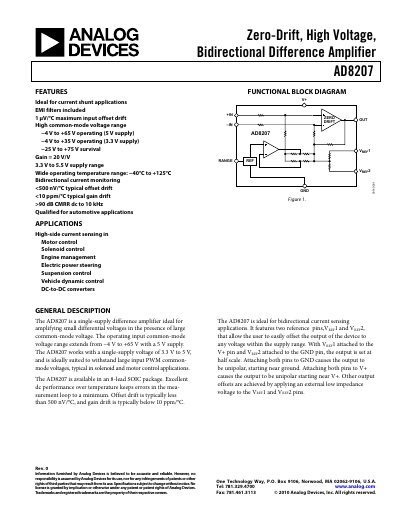
The AD8207 is a single‑supply, zero‑drift difference amplifier designed for amplifying small differential voltages while tolerating large common‑mode voltages. It offers a gain of 20 V/V, a typical input offset drift of less than 500 nV/°C, and a common‑mode voltage range of –4 V to +65 V (5 V supply) or –4 V to +35 V (3.3 V supply). The device is supplied in an 8‑lead SOIC package and includes two reference pins for easy output offset adjustment.
Typical applications include high‑side current sensing in motor control, solenoid control, engine management, electric power steering, and other automotive or industrial systems. The AD8207’s high bandwidth (150 kHz) and robust common‑mode rejection (80‑90 dB) make it suitable for PWM‑rich environments such as H‑bridge motor drives and 3‑phase motor current monitoring.
| Gain | 20 V/V |
|---|---|
| Input Offset Voltage | ±100 µV (typical) |
| Input Offset Drift | ±1 µV/°C (typical) |
| Common‑Mode Rejection Ratio | 80‑90 dB (dc to 20 kHz) |
| Quiescent Current | 2.5 mA (typical) |
| Output Resistance | 2 Ω |
| Bandwidth (Small‑Signal –3 dB) | 150 kHz (typical) |
| Power Supply Rejection Ratio | 80 dB |
| Operating Temperature Range | -40 °C to +125 °C |
The AD8207 provides a fixed gain of 20 V/V.
With a 5 V supply the device tolerates common‑mode voltages from –4 V up to +65 V.
Yes, the AD8207 is qualified for automotive applications and is offered in automotive‑grade versions.