
This document describes how a control system reduces costs for electrical power, sludge removal, and chemical usage. By tightly controlling dissolved oxygen levels in the aeration tanks, costs for electricity and sludge removal can be reduced. Additionally, the control system provides a uniform and stable environment for the microorganisms involved in wastewater processing, resulting in reduced sludge production and chemical usage.
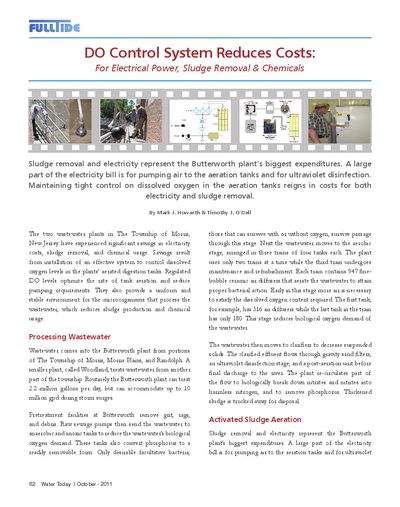
The document describes ABB's dissolved oxygen (DO) control system installed at the Butterworth and Woodland wastewater treatment plants in New Jersey. It explains how tight DO control reduces electricity consumption, sludge production, and chemical usage, leading to significant cost savings and utility rebates.
Key components include the ABB Model 9408 floating‑ball DO sensor, Model 4640 transmitter, and an ACS 600 variable‑frequency drive powering a 150 hp AC motor that drives a positive‑displacement air pump. The system uses a 4‑20 mA signal to maintain a set‑point of 3 ppm DO, with automatic temperature compensation and simple capsule replacement.
| Motor Power | 150 hp AC motor |
|---|---|
| Secondary Motor Power | 125 hp motor |
| DO Signal Range | 4 to 20 mA representing 1 to 10 ppm DO |
| DO Set‑point | 3 ppm |
| Capsule Replacement Interval | Every 9‑12 months |
| Floating Ball Boom Length | Three‑meter long boom |
The system is set to maintain a dissolved oxygen level of 3 ppm.
The disposable capsule should be replaced approximately every 9‑12 months.
It sends a proportional 4‑20 mA signal representing dissolved oxygen levels from 1 to 10 ppm.