
Torex LDO Current Foldback/Current Limiter Circuits Technical Information Paper

This paper introduces the different types of current limiting/current foldback circuits used by Torex LDOs and how to use the VOUT vs. IOUT characteristics to predict the output voltage and output current variations at start-up.

Torex LDO Current Foldback/Current Limiter Circuits Technical Information Paper - cover page
Brand
Torex
Category
Other Electronics
Document type
Application Note
Language
English
Pages
14
File format
PDF
File size
1.4 MB
Published
19 March, 2012
Updated
30 September, 2023
MD5 checksum
32A09BA8524C3C681506273E06861A69

About this manual

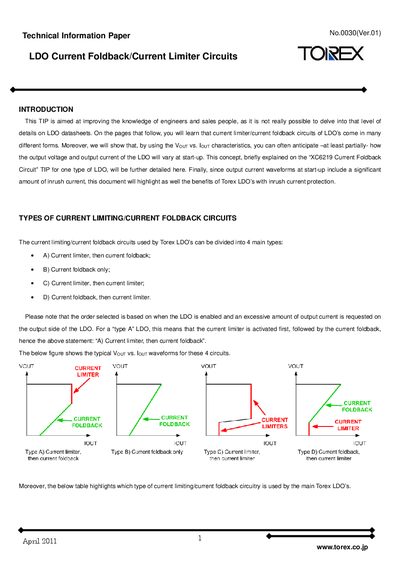
This document details the four main types of current limiting and current foldback circuits used in Torex LDOs. It categorizes these circuits based on the sequence of activation during start-up and over-current conditions, specifically referencing series such as the XC6219 (Type A), XC6221 (Type B), XC6223 (Type C), and XC6505 (Type D).

What's inside

  • Introduction
  • Types of Current Limiting/CURRENT FOLDBACK Circuits
  • Further Comments Before Delving Into Details
  • Case Studies: LDO of Type A
  • Case Studies: LDO of Type B
  • V OUT vs. IOUT Characteristics
  • Start-up Behavior Analysis
  • Inrush Current Protection
  • Thermal Shutdown Circuit
  • Appendix

Frequently asked questions

What are the four main types of current limiting circuits in Torex LDOs?

The four types are: A) Current limiter then current foldback, B) Current foldback only, C) Current limiter then current limiter, and D) Current foldback then current limiter.

Which Torex LDO series is an example of Type A?

The XC6219 series is cited as an example of a Type A LDO.

How does the current foldback circuit act during start-up?

It acts like an inrush protection circuit by forcing the output current to remain on the foldback curve of the V OUT vs. IOUT characteristics.

Download PDF (1.4 MB)

More Torex Manuals


View all Torex manuals →