
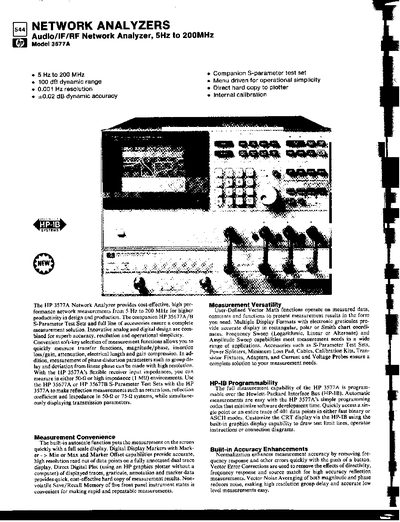
The HP 3577A Audio/IF/RF Network Analyzer covers a frequency range of 5 Hz to 200 MHz and offers 100 dB dynamic range, high resolution, and selectable input impedances for both 50 Ω and 1 MΩ configurations. The manual describes measurement functions such as transfer‑function, magnitude/phase, insertion loss, gain compression, and phase‑distortion parameters, plus built‑in autoscale, marker, and direct‑plot capabilities.
Programming over the HP‑IB interface, calibration procedures, vector‑math functions, and detailed accessory information are also included. Technical specifications, operating conditions, and ordering details are provided for service and integration purposes.
| Frequency Range | 5 Hz to 200 MHz |
|---|---|
| Frequency Resolution | 0.001 Hz |
| Resolution | 0.1 dB |
| Accuracy | +1 dB at +15 dBm and 100 kHz |
| Resolution Bandwidth | 1 kHz, 100 Hz, 10 Hz, or 1 Hz |
| Crosstalk | >100 dB isolation between inputs |
| Stability (Temp.) | < 0.02 dB/°C |
| Weight | 31 kg (net) |
| Dimensions | 222 mm H × 426 mm W × 578 mm D |
It measures from 5 Hz up to 200 MHz.
The instrument can store five front‑panel instrument states in non‑volatile memory.
Remote programming is performed via the Hewlett‑Packard Interface Bus (HP‑IB).