
This document introduces Vishay Draloric 269 series long side termination thick film chip resistors. The series resistors features enhanced power rating, pure tin solder contacts on Ni barrier layer and other features.
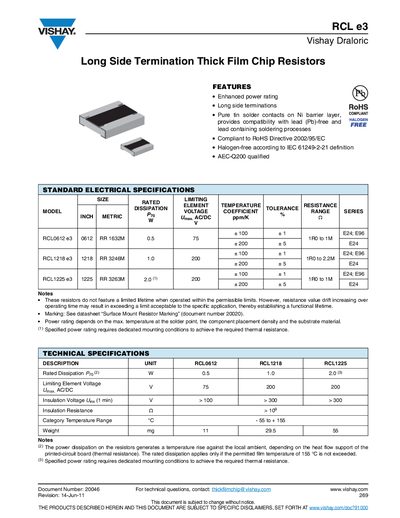
The RCL e3 series from Vishay provides long‑side termination thick‑film chip resistors with enhanced power rating, pure tin solder contacts, and RoHS‑compliant, halogen‑free construction. The document lists electrical characteristics, mechanical dimensions, and packaging options for the RCL0612, RCL1218, and RCL1225 part numbers.
Detailed test procedures follow EN and IEC standards, covering stability, solderability, temperature coefficient, overload, and environmental endurance. The data sheet also includes handling, marking, and warranty disclaimer information.
| Rated Dissipation (P70) | 0.5 W (RCL0612), 1.0 W (RCL1218), 2.0 W (RCL1225) |
|---|---|
| Limiting Element Voltage (Umax) | 75 V (RCL0612), 200 V (RCL1218, RCL1225) |
| Insulation Voltage (Uins, 1 min) | > 100 V (RCL0612), > 300 V (RCL1218, RCL1225) |
| Operating Temperature Range | -55 °C to +155 °C |
| Weight | 11 mg (RCL0612), 29.5 mg (RCL1218), 55 mg (RCL1225) |
| Temperature Coefficient (TCR) | ±100 ppm/K (RCL0612), ±200 ppm/K (RCL1218, RCL1225) |
The RCL1225 resistor is rated for 2.0 W dissipation (P70).
Yes, they are RoHS‑directive 2002/95/EC compliant and halogen‑free according to IEC 61249‑2‑21.
They use pure tin solder contacts on a nickel barrier layer, compatible with lead‑free soldering processes.