
This manual provides instructions for using the Lexmark T640, T642, and T644 printers.
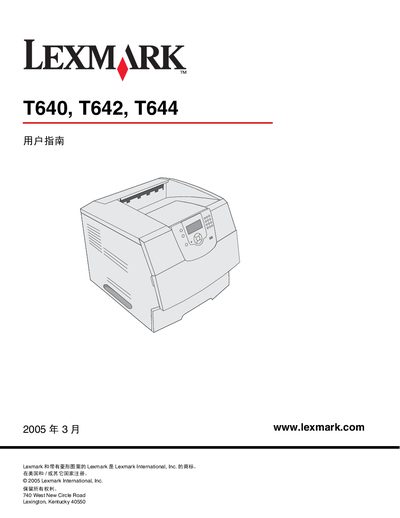
This manual provides detailed information on the Lexmark T640, T642 and T644 printers, including hardware features, control panel functions, and supported media. It guides users through installing drivers for Windows, macOS and UNIX/Linux, as well as configuring network settings and optional accessories.
The guide also covers routine maintenance tasks such as clearing paper jams, replacing consumables, and adjusting printer settings via the built‑in web server. Troubleshooting tips and warranty information are included to help resolve common issues. This manual is written in Chinese.
| Input capacity | 250 sheets (T640), 500 sheets (T642/T644) |
|---|---|
| Output capacity | 250 sheets (T640), 500 sheets (T642/T644) |
| Standard memory (non‑network / network) | T640 64 MB / 64 MB, T642 64 MB / 128 MB, T644 128 MB / 128 MB |
| Maximum memory (non‑network / network) | T640 576 MB / 576 MB, T642 576 MB / 640 MB, T644 640 MB / 640 MB |
Identify the jam location, open the channel cover or paper tray, remove the jammed paper, then press the Go button to resume printing.
The T640 accepts up to 250 sheets of input paper.