
Key facts
Start here
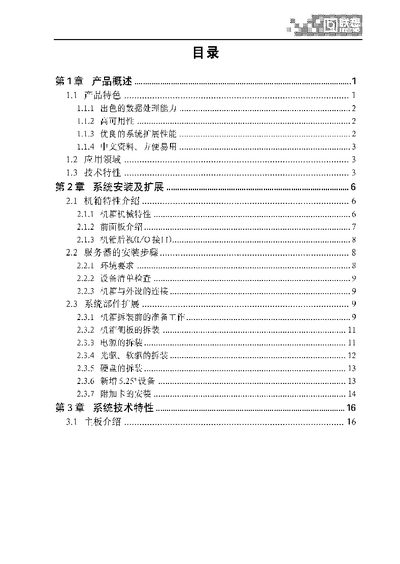
Lenovo ThinkServer 2300T Server User Manual
The ThinkServer 2300T is a rack‑mount server designed for small‑to‑medium businesses and government use. It features an Intel Pentium III (Tualatin) processor, up to 4 GB of PC133 Registered ECC SDRAM, dual‑channel Ultra 160 SCSI, and multiple PCI expansion slots.
This manual covers the server’s physical layout, chassis and motherboard specifications, BIOS configuration, detailed installation procedures for various operating systems (Windows NT/2000, SCO OpenServer, Red Hat, TurboLinux, NetWare), and a troubleshooting section with POST beep‑code diagnostics and component replacement guidance. This manual is written in Chinese.
Lenovo ThinkServer 2300 specifications
| Cache | 512 KB |
|---|---|
| Maximum Memory | 4 GB PC133 Registered ECC SDRAM |
| Memory Slots | 4 × DIMM |
| SCSI Controller | Dual‑channel Ultra 160 SCSI |
| PCI Slots | 2 × 64‑bit/66 MHz, 2 × 32‑bit/33 MHz |
| Power Supply | 300 W, 220 V 50 Hz |
| Dimensions | 520 mm × 195 mm × 190 mm |
| Weight | 28 kg |
All Lenovo ThinkServer 2300 documents by type
Day-to-day operation, settings and troubleshooting. Start here if the product is already set up.
Questions answered in these manuals
What does POST beep code 1‑2‑2‑3 indicate?
It indicates a BIOS ROM calibration error.
What action is required for CPU error code 2‑2‑3‑1?
Replace the CPU.
What is the maximum memory capacity?
The server can hold up to 4 GB of PC133 Registered ECC SDRAM.
From: LENOVO ThinkServer 2300servers computer system user manual
What temperature ranges are recommended for operation?
Non‑operating temperature is –40 °C to 70 °C; operating temperature is 5 °C to 35 °C.
From: LENOVO ThinkServer 2300servers computer system user manual
What is an LVD hard drive?
LVD is the Low‑Voltage Differential standard used by Ultra2 SCSI drives, providing higher data‑transfer speed and stability.