
Operating instructions for WIKA TR21 miniature resistance thermometers for sanitary applications, covering design, safety, commissioning, and technical specs.
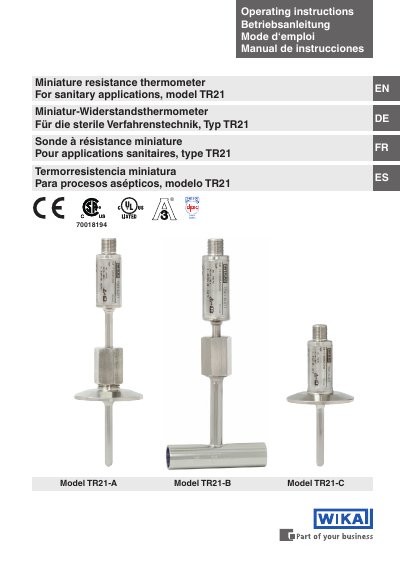
This document provides operating instructions for the WIKA TR21 miniature resistance thermometer, designed for sanitary applications. It covers general information, design and function, safety guidelines, transport and storage, commissioning, operation, configuration, and technical specifications. The thermometer includes a temperature sensor and protection tube, with detachable connections in some models to allow sensor removal without shutting down the process. Safety and personnel qualifications are emphasized, and the document includes details on materials, approvals, and environmental conditions for proper use.
The TR21 is available in different variants (TR21-A, TR21-B, TR21-C) with various process connections and protection tubes, suitable for temperature ranges from -30°C to +250°C. It can be used with direct sensor output or converted to a 4–20 mA signal. The document also includes information on labeling, maintenance, and compliance with hygiene and safety standards such as EHEDG and 3-A.
| Operating Temperature Range | -30 … +150 °C [-22 ... +302 °F] or -30 … +250 °C [-22 ... +482 °F] |
|---|---|
| Autoclavable Conditions | Max. 134 °C, 3 bar abs., 100 % r. h., duration 20 min., max. 50 cycles |
| Ingress Protection (IP Code) | IP67 per IEC/EN 60529, IP69 per IEC/EN 60529, IP69K per ISO 20653 |
| Weight | 0.3 ... 2.5 kg (depending on version) |
The TR21 thermometer measures temperatures from -30°C to +150°C or -30°C to +250°C, depending on the model variant.
Yes, it can be autoclaved up to 134°C, 3 bar absolute, 100% relative humidity for 20 minutes, up to 50 cycles.
The case with connected connector has IP67, IP69, or IP69K ratings depending on the standard.
Only skilled electrical personnel with appropriate training and knowledge of local regulations and standards should operate or install the TR21.