
This document describes the features and characteristics of the fieldbus temperature transmitters with HART® digital display module, including models TIF50-S, TIF50-F, TIF50-I, TIF52-S, TIF52-F, and TIF52-I.
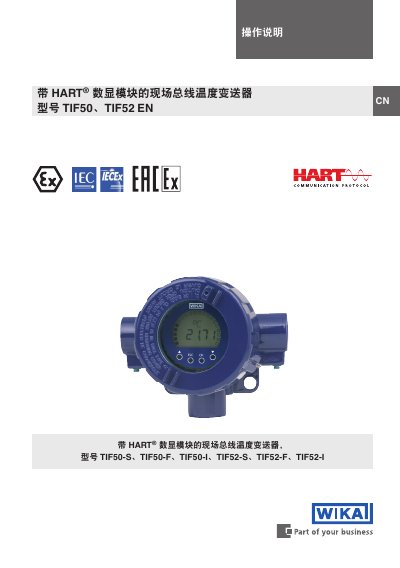
This manual provides operating instructions for the WIKA TIF50 and TIF52 series of fieldbus temperature transmitters equipped with a HART® digital display module. The document covers general information, safety guidelines, technical specifications, design features, commissioning procedures, electrical connections, user interface operation, maintenance, troubleshooting, and disposal. This manual is written in Chinese.
| Display Type | LCD, rotatable in 10 degree steps |
|---|---|
| Measurement Rate | 4/s |
| Accuracy (TIF50) | ±0.1 % of range |
| Operating Temperature Range | -60 ... +85 °C (Model TIF50) |
| Protection Rating | IP66 |
The instruments can be used together with resistance thermometers (RTD), thermocouples (TC), resistors, and potentiometers.
Yes, specific versions are available with explosion protection (flameproof or intrinsic safety), as indicated by suffixes F and I.
The maximum allowed current is 100 mA, with a voltage drop of less than 3V DC.