
Toyo guidelines for applying tire load and inflation tables when replacing tires with optional sizes, including plus sizes, using TRA and ETRTO data.
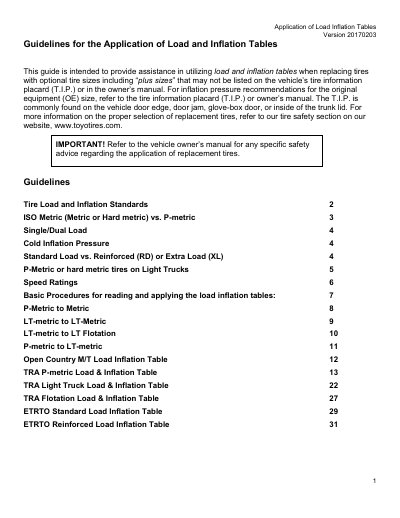
Toyo's "Guidelines for the Application of Load and Inflation Tables" (Version 20170203) explains how to use load and inflation tables when replacing tires with optional sizes, including plus sizes, that may not appear on the vehicle tire information placard or owner's manual. It describes TRA, ETRTO and JATMA standards and gives basic procedures for matching replacement tire load capacity to the original equipment tire.
The document includes examples for P-metric to Metric, LT-metric to LT-metric, LT-metric to LT Flotation and P-metric to LT-metric applications, plus load and inflation tables for Open Country M/T, TRA P-metric, TRA Light Truck, TRA Flotation, ETRTO Standard Load and ETRTO Reinforced tires. It also covers single/dual load, cold inflation pressure, standard load vs. reinforced/extra load, P-metric or hard metric tires on light trucks, and speed ratings.
| TRA P225/55R17 95T maximum load capacity | 1521 lbs at 35 psi |
|---|---|
| 225/55R17 97T maximum load capacity | 1609 lbs at 36 psi |
| Light truck load reduction factor for P-metric/metric tires | 1.101; load capacity divided by 1.1 |
| Dual tire load capacity reduction | 9% of single load capacity |
It is commonly found on the vehicle door edge, door jam, glove-box door, or inside of the trunk lid.
Tires should be checked when cold, after the vehicle has been parked for at least three hours or driven less than one mile.
The installer should inform the owner of the new required pressure and place a sticker or decal over the vehicle tire placard showing the new tire size and recommended inflation pressure.
The load capacity is reduced by 9% of the single load capacity.