
TE Connectivity's DIP Sockets Quick Reference Guide covers 6–48 position sockets, contact options, technical specifications, part numbers and applications.
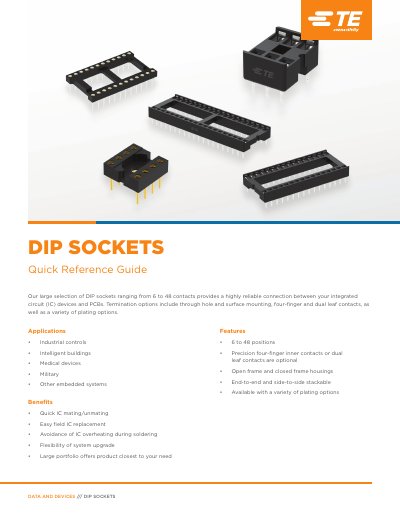
TE Connectivity's DIP Sockets Quick Reference Guide presents the company's DIP socket range from 6 to 48 positions for connecting integrated circuit (IC) devices to PCBs. It lists through-hole and surface-mount termination options, four-finger and dual leaf contacts, open and closed frame housings, and plating choices.
The guide gives technical specifications for four-fingered and dual leaf contacts, application examples including industrial controls, medical devices, military and other embedded systems, and a product matrix with RoHS-compliant and non-RoHS-compliant part numbers. It also answers common questions about socket use and about stamped versus machined contacts, 300 CL/600 CL centerlines, and LDR/OTC frame styles.
| Positions | 6 to 48 positions |
|---|---|
| Insulator material (four-fingered) | Thermoplastic polyester, UL94 V-0 |
| Insulator material (dual leaf) | 30% glass-filled PBT thermoplastic, black |
| Contact material | Beryllium copper (four-fingered); phosphorous bronze (dual leaf) |
| Contact rating | 3 A/pin (four-fingered); 1 A/pin (dual leaf) |
| Contact resistance | 10 milliohms max (four-fingered); 20 milliohms max (dual leaf) |
| Insertion force | 179 g average machined contact; 134 g average stamped contact; 300 g max dual leaf |
| Dielectric withstanding | 1,000 V RMS per MIL-STD-1344 (open frame) |
| Plating options | Gold, tin, tin/lead (sleeve); gold/low gold/tin (contact) |
TE lists component test, upgrade and exchange, flexibility in IC design, assembly and cost savings as benefits of using a socket.
TE says stamping and machining are connector manufacturing technologies, and it uses stamping as an economical alternative to traditional screw machined contacts.
300 CL means a 0.3 in (7.62 mm) centerline; 600 CL means a 0.6 in (15.24 mm) centerline.
LDR means the frame is ladder style, and OTC means the frame is over-the-component style.