
This document introduces the features and applications of high-precision force sensors designed and manufactured by TE. These sensors have the advantages of low cost, durability, and long-term stability, and are suitable for applications such as electric mechanical flight control systems, testing and measurement, and OEM force sensors. The document also provides detailed technical specifications and typical applications of different models of force sensors.
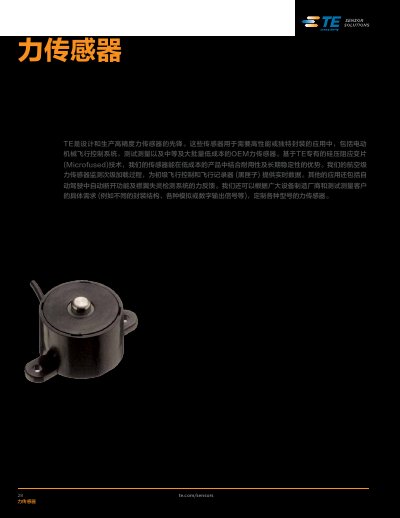
This document introduces TE Connectivity as a pioneer in designing and manufacturing high-precision force sensors. The text highlights the use of proprietary Microfused silicon strain gauge technology to ensure durability and long-term stability, even in low-cost products.
The brochure covers a wide range of sensor series within the MEAS line, including coin-style designs (FX19, FS19), button styles (FC22, FC23), and various bolted or cantilever configurations. It also details specific automotive applications such as seatbelt load sensors and steering wheel torque measurement. This manual is written in Chinese.
| Technology | Silicon strain gauge (Microfused) |
|---|---|
| Operating Temperature Range | -40℃~85℃ (varies by model) |
| Output Signal | 100 mV or 0.5~4.5 Vdc |
| Linearity and Hysteresis | ±1% FSO (varies by model) |
They are based on TE's proprietary Microfused silicon strain gauge technology.
Applications include electric/mechanical flight control systems, test and measurement, and OEM uses.