
TE Connectivity quick reference guide to DIP sockets with 6 to 48 positions, four-finger and two-piece terminals, specifications and part numbers.
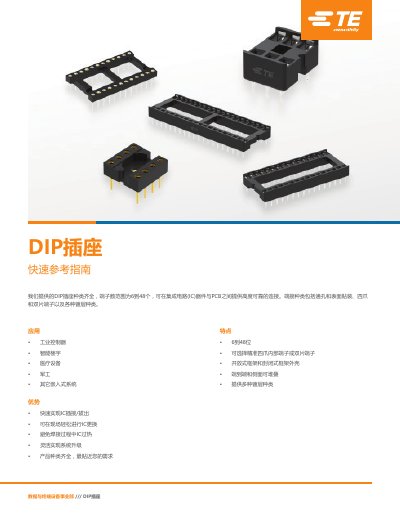
This quick reference guide from TE Connectivity covers the company's DIP socket range. The sockets are offered with 6 to 48 positions and with through-hole or surface-mount termination, using either precision four-finger or two-piece terminals, in open-frame and closed-frame housings with several plating options. Listed applications include industrial controllers, smart buildings, medical equipment, military and other embedded systems.
The guide explains the design features of both terminal styles, gives technical specifications for the four-finger and two-piece versions, and provides product series tables with RoHS-compliant and non-RoHS part numbers by position count. A part-number table for two-piece terminal sockets, a short FAQ and TE technical support contacts close the document. This manual is written in Chinese.
| Number of positions | 6 to 48 |
|---|---|
| Terminal resistance (four-finger) | 10 mΩ max |
| Terminal resistance (two-piece) | 20 mΩ max |
| Dielectric withstanding voltage | 1000 V RMS, open frame and closed frame |
| Frame material | Thermoplastic polyester, UL94 V-0, 30% glass-fiber filled, black |
| Insertion force (machined terminals) | 179 g average |
| Insertion force (stamped terminals) | 134 g average |
| Withdrawal force | 63 g average, 20 g minimum |
| Accepted IC pin size | .009” x .015” to .011” x .020”, or .016” to .021” diameter |
The guide lists component testing, upgrading and swapping, IC design flexibility, and assembly cost savings as the advantages of using a socket.
They are different connector manufacturing technologies; TE developed and produced DIP socket terminals using stamping as an economical alternative to traditional machined terminals.
300 CL means the product has a 0.3 inch (7.62 mm) centerline, so 600 CL means a 0.6 inch (15.24 mm) centerline.
LDR means the frame is a ladder style and OTC means the frame is a style above the component.