
Technical datasheet for the SC7LC30 proximity and ambient light sensor with specifications, register map and operation details.
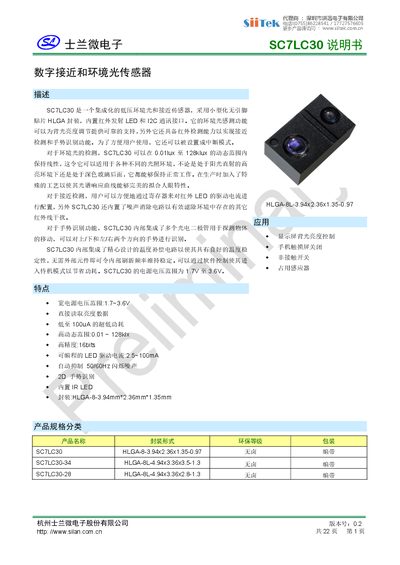
The SC7LC30 is an integrated low‑voltage proximity and ambient‑light sensor featuring a pin‑less HLGA package, built‑in IR LED and I²C interface. It supports a wide dynamic range (0.01 lux‑128 klux) and can operate in interrupt or sleep modes for power‑efficient applications.
The document provides electrical parameters, pin configuration, register definitions, state‑machine operation, package dimensions and recommended soldering conditions, enabling designers to integrate the sensor into display backlight control, touch‑screen disable, non‑contact switches and other applications. This manual is written in Chinese.
| Supply voltage range | 1.7 V – 3.6 V |
|---|---|
| Dynamic range (ambient light) | 0.01 lux – 128 klux |
| Resolution | 16 bits |
| LED driver current (programmable) | 2.5 mA – 100 mA |
| Power consumption (typical) | 100 µA ultra‑low power |
| I²C clock frequency | 400 kHz |
| Operating temperature range | -40 °C – 85 °C |
| Package | HLGA‑8 3.94 × 2.36 × 1.35 mm |
The device uses a fixed 7‑bit I²C slave address of 0x39.
Set the PON bit to 0 in the STATE register; the chip then enters low‑power sleep mode.
The LED driver current can be programmed from 2.5 mA up to 100 mA.