
A conference paper describing the principle, design and field application of the Siemens Oxymat 6 magnetic‑micro‑pressure oxygen analyzer in a styrene plant.
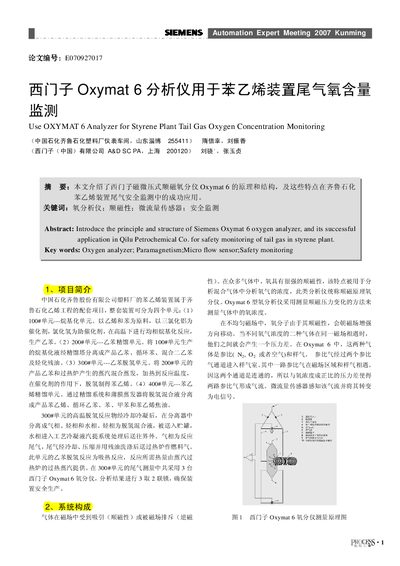
The paper introduces the magnetic‑micro‑pressure measurement principle of the Siemens Oxymat 6 oxygen analyzer and its key features such as rapid response, high stability and corrosion resistance. It explains how the instrument uses a micro‑flow sensor to detect pressure differences between reference and sample gases, converting them into an electrical signal.
The document details the installation of three Oxymat 6 units at Qilu Petrochemical’s styrene plant, the sample‑gas pre‑treatment system, and the safety‑interlock logic (two‑out‑of‑three voting). It also reports on operational experience, including response time (T90 = 1.5 s), vibration compensation, and maintenance improvements that enhanced measurement stability. This manual is written in Chinese.
| Measurement principle | Magnetic micro‑pressure (paramagnetic) oxygen measurement |
|---|---|
| Response time (T90) | 1.5 seconds |
| Oxygen measurement range | 0–2 % O₂ |
| Output signals | 4‑20 mA analog and digital signal |
| Vibration compensation | Built‑in micro‑flow sensor used as vibration sensor |
| Sensor exposure | Micro‑flow sensor does not contact sample gas |
| Measurement chamber | Removable and washable design |
The Oxymat 6 has a T90 response time of 1.5 seconds, providing fast detection of oxygen levels.
It includes an additional micro‑flow sensor that acts as a vibration sensor, and its signal is used to compensate the oxygen measurement.
The analyzer outputs both a 4‑20 mA analog current signal and a digital signal for DCS integration.
Yes, the measurement chamber is designed to be removable and washable, allowing easy cleaning of contaminants.