
The Shure MX395 low‑profile boundary microphone manual provides overview, installation steps, DIP switch settings, pin assignments and full specifications.
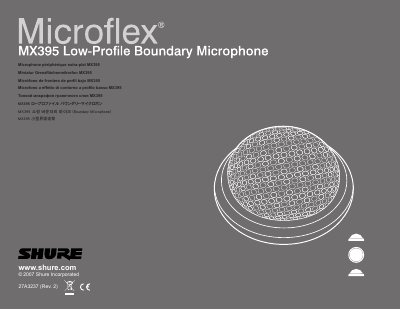
The MX395 is a low‑profile boundary microphone designed for boardrooms and other aesthetically demanding spaces. Its compact 2.5 cm diameter and 2 cm protrusion deliver clear, high‑quality sound while maintaining a sleek appearance.
The manual covers installation (including proper wing‑nut torque and orientation), DIP‑switch configuration for low‑cut filtering, LED indicator wiring, and detailed electrical specifications such as frequency response, sensitivity, and power requirements. This manual is written in Chinese.
| Type | Condensator (Elektret) |
|---|---|
| Frequency Response | 50–17000 Hz |
| Output Impedance | 150 Ω (EIA nominal) |
| Sensitivity (Cardioid) | –35 dBV/Pa (18 mV) |
| Maximum SPL (Cardioid) | 121 dB SPL |
| Equivalent Noise (Cardioid) | 28 dB SPL (A‑weighted) |
| Dynamic Range (Cardioid) | 93 dB |
| Power Supply (MX395) | 11–52 V DC phantom, 2.0 mA |
| LED Input Logic | Active low ≤1.0 V, TTL compatible |
Do not overtighten the wing nut and make sure the recessed side faces the speaker.
Position 1 selects the full frequency range (no low‑cut filter).
The LED input is active low with a maximum of 1.0 V and is TTL compatible.
It needs a phantom supply of 11–52 V DC drawing 2.0 mA.