
This user manual describes the Rohde & Schwarz SMBV100B and SMW200A satellite navigation test platform, its features, configuration and testing procedures.
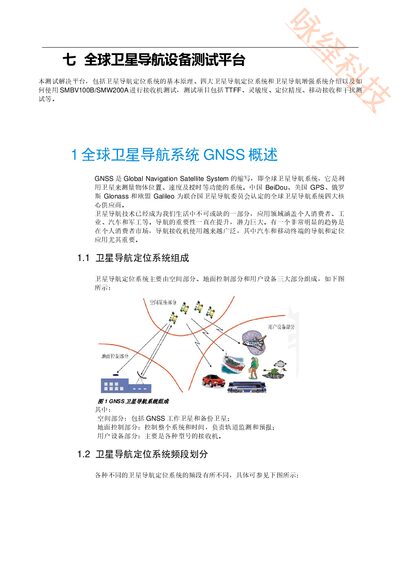
The document provides an overview of global navigation satellite systems (GNSS) and explains how the Rohde & Schwarz test platform uses the SMBV100B and SMW200A instruments to evaluate receiver performance, including TTFF, sensitivity, positioning accuracy, and interference testing.
It details the capabilities of the two vector signal generators, their frequency coverage, multi‑antenna and multi‑vehicle support, and how to configure hardware and software options for realistic GNSS simulation scenarios. This manual is written in Chinese.
| GNSS frequency bands | L1, L2, L5 |
|---|---|
| Number of GNSS channels (SMBV100B) | 6 to 60 |
| Number of RF outputs (SMBV100B) | 1 |
| Maximum simulated antennas (SMBV100B) | 1 |
| Maximum simulated vehicles | 1 (SMBV100B) / 2 (SMW200A) |
| Signal dynamics – Velocity max | 600 m/s (SMBV100B) / 10 000 m/s (SMW200A) |
| Interference generation | Yes |
The SMBV100B can simulate up to 102 GNSS satellites.
The SMW200A supports L1, L2 and L5 GNSS frequency bands.
Yes, both the SMBV100B and SMW200A can generate interference scenarios such as CW jamming and AWGN.