
This document outlines the basic characteristics of hydraulic components and equipment, including dimensions, tolerances, operating conditions, and leakage…
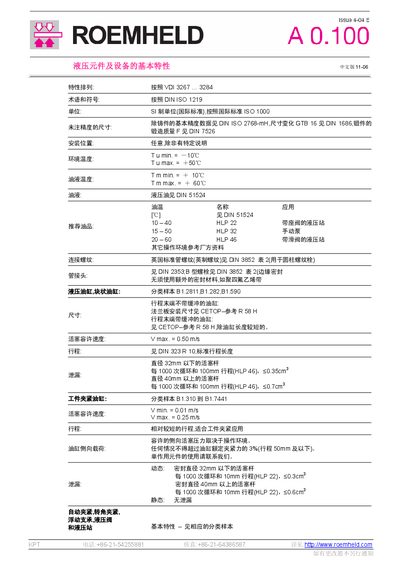
The document provides a comprehensive list of basic characteristics for hydraulic components and equipment, covering terminology, symbols, units, dimensional tolerances, installation positions, and environmental limits. It references international standards such as DIN, ISO, and VDI for consistent specification.
Key data include ambient and oil temperature ranges, recommended hydraulic oil standards, thread and pipe fitting specifications, cylinder classifications, piston speed limits, stroke lengths, and leakage limits. Contact information and a reference to the Roemheld website are also included. This manual is written in Chinese.
| Ambient temperature range | -10 °C to +50 °C |
|---|---|
| Oil temperature range | +10 °C to +60 °C |
| Recommended hydraulic oil | DIN 51524 |
| Thread connection standard | British standard pipe thread (DIN 3852) |
| Maximum piston allowable speed | 0.50 m/s |
| Leakage limit for pistons ≤32 mm diameter | ≤0.35 cm³ per 1000 cycles and 100 mm stroke |
The ambient temperature can range from -10 °C to +50 °C.
Leakage must not exceed 0.35 cm³ per 1000 cycles and a 100 mm stroke.
Thread connections follow the British standard pipe thread as defined in DIN 3852.
The recommended hydraulic oil conforms to DIN 51524.