
Molecular Devices SpectraMax iD5 leaflet: five read modes, NFC filter identification, touchscreen control, western blot detection and QuickSync data push.
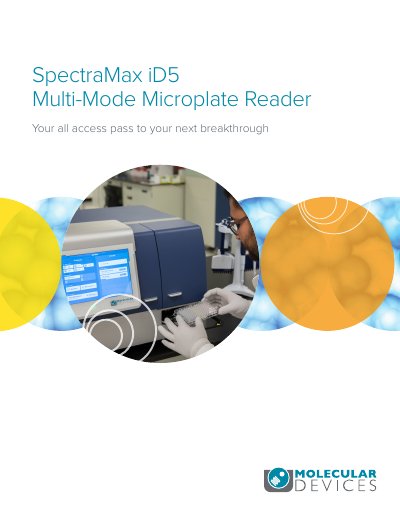
This leaflet describes the SpectraMax iD5 Multi-Mode Microplate Reader from Molecular Devices. It is a five-mode reader with built-in absorbance, fluorescence, luminescence, time-resolved fluorescence (TRF) and tunable fluorescence polarization (FP) read modes, and it can be expanded to include bottom-read luminescence, TR-FRET, HTRF, BRET, dual luciferase reporter assays with injectors and western blot detection.
The document covers key benefits such as automatic filter identification using built-in NFC tags, a large high-resolution touchscreen running SoftMax Touch Software so protocols can be run without a dedicated workstation, temperature control up to 66°C, well scanning up to a 20x20 read matrix, plate formats from 6- to 384-wells, and QuickSync data push to workstations on the same network. A section on SoftMax Pro GxP Compliance Software describes controlled user access, electronic signatures and audit trails for regulated laboratories.
| Read modes | Absorbance, fluorescence, luminescence, time-resolved fluorescence (TRF), tunable fluorescence polarization (FP) |
|---|---|
| Temperature control | Ambient up to 66°C |
| Shaking modes | Linear, orbital and double orbital |
| Plate formats | 6- to 384-well plates |
| Well scanning | Up to 20x20 read matrix |
| Light source | Xenon flash lamp |
| Detector | Ultra-cooled photomultiplier tube (PMT) |
| Optical pathway | Four-monochromator with high efficiency gratings |
| Injector dead volume | 10 µL |
It has built-in absorbance, fluorescence, luminescence, time-resolved fluorescence (TRF) and tunable fluorescence polarization (FP) read modes.
Yes. The large touchscreen interface has embedded SoftMax Touch Software for setting up custom protocols and running experiments without a dedicated computer workstation.
Temperature control is adjustable from ambient up to 66°C.
Built-in near-field communication (NFC) tags let the reader automatically detect the filter identification code and recognize the slide and filter configuration.