
The MCP2120 datasheet from Microchip details features, pinout, operation, and specifications of the infrared encoder/decoder.
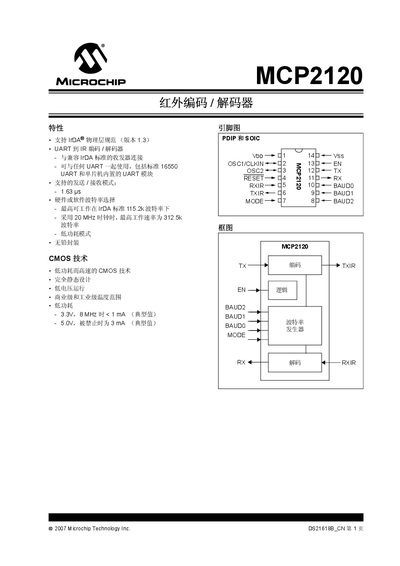
The MCP2120 is a low‑cost, high‑performance fully static infrared encoder/decoder that sits between a UART and an IR optical transceiver. It converts UART data to IR pulses for transmission and decodes received IR pulses back to UART data, complying with the IrDA physical‑layer specification.
Key features include hardware and software selectable baud rates up to 312.5 kbaud, low‑power operation (<1 mA at 3.3 V), 14‑pin DIP and SOIC packages, and a temperature range of –40 °C to +85 °C. The device can be evaluated with the MCP212X development board and various PICDEM demo boards. This manual is written in Chinese.
| Operating Voltage (Low‑Power Mode) | 3.3 V, <1 mA typical |
|---|---|
| Operating Voltage (Low‑Power Mode) at 5 V | <3 mA typical |
| Maximum Baud Rate | 312.5 kbaud |
| Package Types | 14‑pin DIP, 14‑pin SOIC |
| Temperature Range | -40 °C to +85 °C |
The default baud rate is FOSC / 768.
Pull the MODE pin low to enter command mode.
It is offered in 14‑pin DIP and 14‑pin SOIC packages.
Typical current is less than 1 mA at 3.3 V and less than 3 mA at 5 V.