
The Kistler K-1 Vehicle Payload User's Guide provides details on vehicle performance, payload design criteria, environments, and launch operations.
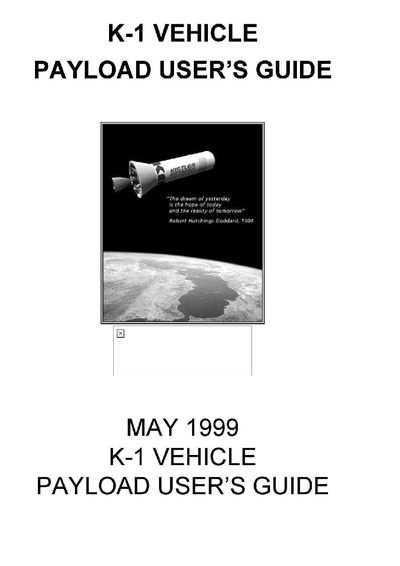
This guide describes the K-1 reusable launch vehicle, its performance capabilities, payload environments, and interfaces, helping customers plan and integrate their payloads. It includes program overviews, vehicle specifications, and safety procedures.
Key sections cover the vehicle overview, performance data, payload module description, mechanical and electrical interfaces, environmental conditions, mission management, launch operations, and safety approval processes.
| Overall vehicle length | 36.9 m (121 ft) |
|---|---|
| Liftoff weight | 382,300 kg (841,000 lbm) |
| Launch Assist Platform diameter | 6.7 m (22 ft) |
| Launch Assist Platform weight | 250,500 kg (551,000 lbm) |
| Orbital Vehicle length | 18.6 m (61 ft) |
| Orbital Vehicle diameter | 4.3 m (14 ft) |
| Orbital Vehicle weight | 131,800 kg (290,000 lbm) |
The K-1 vehicle is 36.9 m (121 ft) long.
K-1 launch operations are performed at Woomera in Australia and at the Nevada Test Site in the United States.
The safety approval follows a three‑phase approach: hazard identification, hazard mitigation, and compliance verification.