
A 2009 GSK guide for selecting solvents based on environmental, health, flammability, and regulatory criteria.
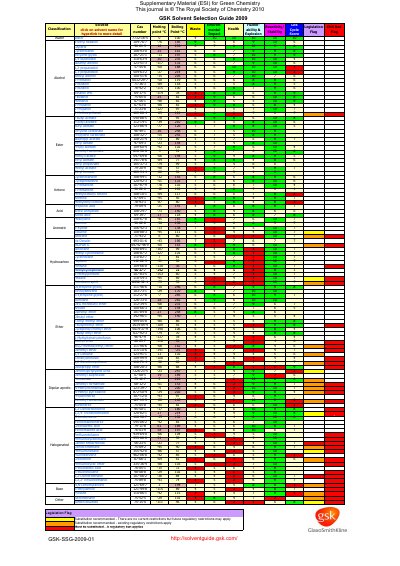
This 2009 GSK guide provides a detailed comparison of solvents based on environmental impact, health effects, flammability, reactivity, and regulatory restrictions. It includes tables with melting and boiling points, waste handling, and substitution recommendations. The guide highlights solvents with regulatory bans or restrictions, such as benzene and chlorinated solvents, and suggests alternatives like water, ethanol, or dimethyl carbonate. It also includes a section on greenest options and EHS regulatory alerts.
| Document Year | 2009 |
|---|---|
| Solvent Type | Water, Alcohols, Esters, Ketones, Acids, Aromatics, Hydrocarbons, Ethers, Dipolar Aprotics, Halogenated |
| Environmental Impact Score | 0 to 10 |
| Legislation Flag | y (substitution recommended), o (substitution recommended), r (must be substituted) |
Water, 1-Butanol, Ethanol/IMS, 1-Propanol, t-Butanol, Methanol, 2-Propanol, 2-Methoxyethanol, t-Butyl acetate, Isopropyl acetate, Ethyl acetate, Dimethyl carbonate, Acetonitrile, and others are listed as greenest options.
Solvents marked with 'r' must be substituted due to regulatory bans, including benzene, chloroform, carbon tetrachloride, and 1,2-dichloroethane.
Water boils at 100°C, ethanol at 78°C, methanol at 65°C, and acetone at 56°C.