
Corning ELISA Workflow Guide covering microplate and surface selection, the basic ELISA workflow, and related microplates, reservoirs, and sealing products.
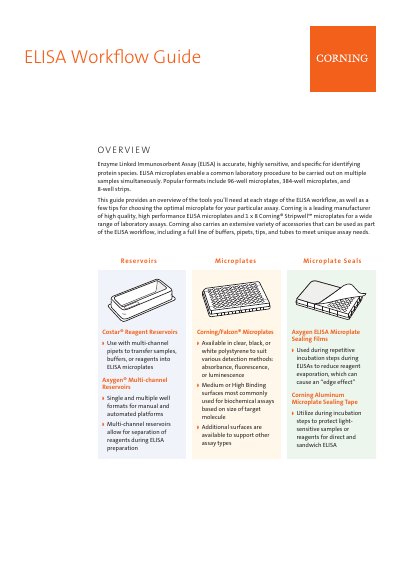
This Corning ELISA Workflow Guide describes the tools used at each stage of an ELISA workflow, including microplates, reagent reservoirs, and microplate seals. It lists Corning, Falcon, Costar, and Axygen product options with catalog numbers and specifications.
The guide outlines a basic workflow: select the microplate and surface, coat, block if required, add detection substrate solution, and read the signal. It also explains microplate color and surface choices and lists available ELISA technical documents.
| Popular ELISA microplate formats | 96-well microplates, 384-well microplates, and 8-well strips |
|---|---|
| Medium binding surface binding capacity | ~200 ng IgG/cm2 |
| High binding surface binding capacity | ~500 ng IgG/cm2 |
| Costar reagent reservoir volume | 50 mL or 100 mL |
| Axygen multi-channel reservoir range | 1- to 12-channel reservoirs |
| Axygen ELISA sealing film thickness | 80 µm |
| Axygen ELISA sealing film working temperature | 104°C |
| Microplate color options | Clear, black, or white polystyrene |
The guide lists 96-well microplates, 384-well microplates, and 8-well strips as popular formats.
The high binding surface has a binding capacity of about 500 ng IgG/cm2.
They are used during repetitive incubation steps to reduce reagent evaporation, which can cause an edge effect.
They are used during incubation steps to protect light-sensitive samples or reagents in direct and sandwich ELISA.