
Corning Filtration and Ultrafiltration Product Guide

A guide for selecting Corning filtration products, covering pore size selection, membrane material compatibility, housing materials, and throughput…
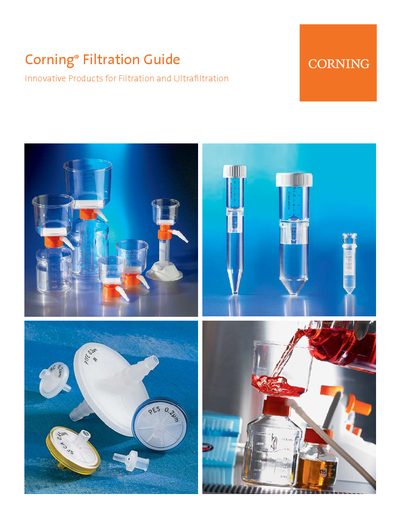

Corning Filtration and Ultrafiltration Product Guide - cover page
Brand
CORNING
Document type
Product Leaflet
Language
English
Pages
20
File format
PDF
File size
547 KB
Published
13 October, 2026
Updated
13 October, 2026
MD5 checksum
1C20F439EA24A3249214D30050BE117F

About this manual

This document provides guidance on selecting the best filter for various laboratory applications. It outlines a four-step process: matching the application with the appropriate pore size, choosing the correct membrane and housing material based on chemical compatibility, optimizing flow rate by selecting the right membrane area, and choosing the best filter design.

What's inside

  • Selecting the Best Filter
  • Pore Size Selection
  • Membrane Characteristics
  • Housing Materials
  • Chemical Compatibility
  • Throughput Volumes

Frequently asked questions

What pore size is recommended for removing Mycoplasma?

A 0.1 µm pore filter is recommended for Mycoplasma removal.

What pore sizes are used for routine laboratory sterilization?

Routine laboratory sterilization is usually done with 0.2 or 0.22 µm pore filter membranes.

What is the expected throughput for a 50 mm disc filter?

The expected throughput for a 50 mm disc filter is 100-500 mL.

Download PDF (547 KB)

More CORNING Manuals


View all CORNING manuals →