
This application note explains eye‑pattern measurement fundamentals, typical setups, and analysis methods using Anritsu MP2100A BERTWave and MP1026B Bit Master.
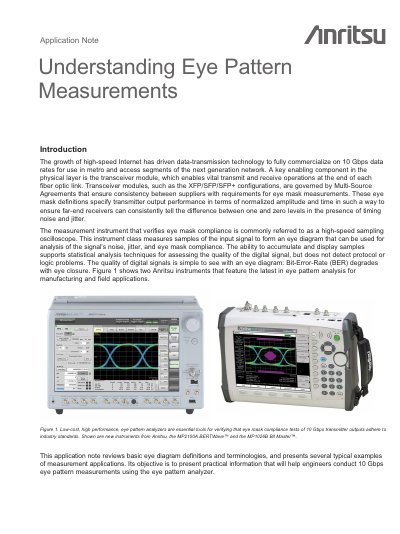
The note introduces eye‑pattern measurements for high‑speed optical links, describing how eye diagrams reveal amplitude and timing impairments that affect BER. It explains the role of sampling oscilloscopes and Anritsu eye‑pattern analyzers in verifying compliance with eye‑mask specifications.
It then details the measurement technology, typical instrument configurations (e.g., MP1800A SQA with MP1026B Bit Master), histogram‑based analysis, and definitions of key parameters such as one/zero levels, eye amplitude, crossing percentage, jitter, rise/fall time, eye width, and extinction ratio.
| Bandwidth | 5 GHz |
|---|---|
| Data‑rate range | 100 Mbps – 1.5 Gbps and beyond |
| Sample rate (under‑sampling) | ≈ 100 ksps |
| Eye amplitude example | ≈ 500 mV (491.65 mV) |
Eye crossing percentage is the ratio of the crossing level to the one‑zero level span, calculated as 100 × [(crossing level – zero level) / (one level – zero level)].