
This document discusses the design considerations for high-speed differential ADC drivers, including the advantages of differential inputs and the functions of ADC drivers.
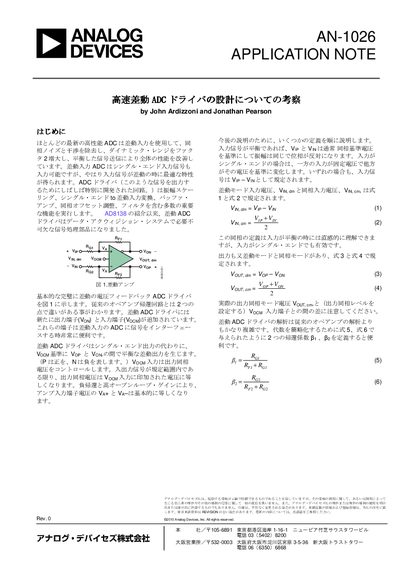
The note provides a detailed analysis of high‑speed differential ADC driver design, including input termination, common‑mode voltage range, and coupling options. It explains how proper termination and impedance matching improve performance and reduce distortion.
It also presents example calculations, noise and distortion analysis, and a comprehensive table of ADC driver specifications (e.g., AD8132, AD8137, AD8138). The document helps designers select appropriate drivers and configure circuits for optimal bandwidth and output swing. This manual is written in Japanese.
| Maximum bandwidth (example driver) | 350 MHz (AD8132) |
|---|
Terminating the transmission line with its characteristic impedance ensures impedance matching, which yields optimal performance for high‑speed signals.