
This datasheet details the AD8229, a low-noise instrumentation amplifier designed for operation up to 210°C with 1 nV/√Hz input noise.
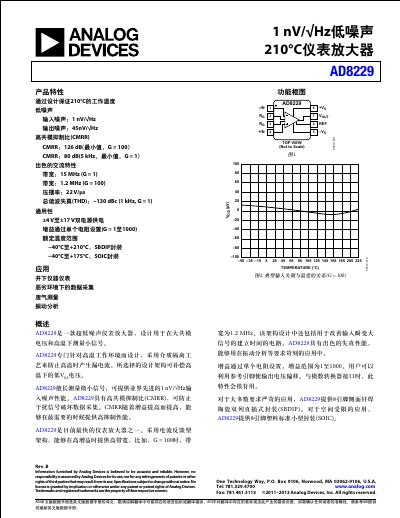
The AD8229 is a low-noise instrumentation amplifier designed for measuring small signals in high common-mode voltage and high-temperature environments. It features industry-leading 1 nV/√Hz input noise performance and a high common-mode rejection ratio (CMRR) that improves with gain. The device is specifically engineered for harsh environments, such as downhole instrumentation and exhaust gas measurement, utilizing a dielectric isolation process to prevent leakage currents at elevated temperatures.
The amplifier supports a wide operating temperature range of -40°C to +210°C for SBDIP packages and -40°C to +175°C for SOIC packages. It offers a gain range from 1 to 1000 set by a single external resistor and includes a reference pin for output level shifting. The document provides comprehensive electrical specifications, absolute maximum ratings, typical performance characteristics, and application guidelines. This manual is written in Chinese.
| Input Noise Voltage Density | 1 nV/√Hz |
|---|---|
| Output Noise Voltage Density | 45 nV/√Hz |
| Common-Mode Rejection Ratio (G=100) | 126 dB |
| Bandwidth (G=1) | 15 MHz |
| Bandwidth (G=100) | 1.2 MHz |
| Slew Rate | 22 V/µs |
| Operating Temperature (SBDIP) | -40°C to +210°C |
| Operating Temperature (SOIC) | -40°C to +175°C |
| Gain Range | 1 to 1000 |
| Supply Voltage Range | ±4 V to ±17 V |
The AD8229 has an input noise density of 1 nV/√Hz.
The SBDIP package is rated for operation from -40°C to +210°C.
The gain is set by a single external resistor connected to the RG pins.
At a gain of 100, the bandwidth is 1.2 MHz.