
Operation manual for the Agilent 8697 Headspace Sampler covering headspace techniques, method parameters, sequences, settings, and maintenance feedback.
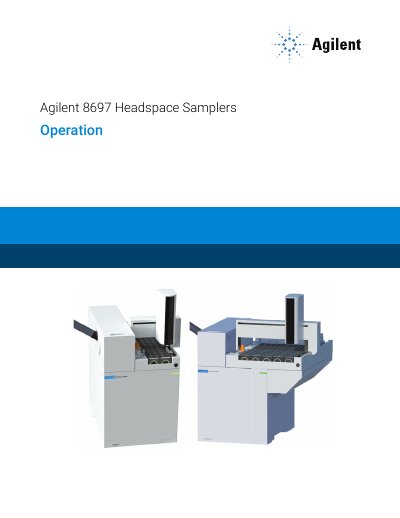
This operation manual covers the Agilent 8697 Headspace Sampler. It introduces headspace sampling techniques and describes routine operation, consumables, sample vials, HS method parameters, sequences, settings, and how the sampler processes a sample vial.
The later sections cover method development, the optional cooling plate accessory, and Early Maintenance Feedback. The document is identified as Manual Part Number G4511-90004, second edition, April 2023.
| Cooling plate vial temperature range | 4 °C to 80 °C |
|---|---|
| Vial position temperature tolerance | within +1 to -3 °C of the cooling plate sensor reading |
| Recommended coolant temperature range | 4 to 80 °C |
| Pressure pump pressure | 1.5 to 2.5 psi |
| Suction pump vacuum limit | cannot exceed –4 psi |
| Recirculator cooling power | 1000 to 2000 watts |
It is a technique for analyzing volatile components of a sample matrix by sampling the ambient volume above the matrix, where volatile compounds exist in gaseous form.
The manual describes dynamic headspace sampling, static headspace sampling, and Solid Phase Micro Extraction.
In the valve and loop system, it uses a sample loop of known volume to collect the sample.
Perform several blank runs and use them to check for carryover.