
Agilent 850-DS dissolution sampling station method setup quick start guide with key parameters, cleaning, volume calibration and manual links.
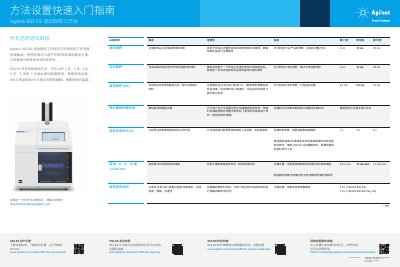
This quick start guide describes how the Agilent 850-DS Dissolution Sampling Station integrates with existing workflows to give unattended sampling and cleaning, with the aim of raising analysis efficiency and removing variability. The station supports several dissolution methods and can be used with USP Apparatus 1, 2, 3, 5, 6 and 7 dissolution testers, and results can be collected in traditional test tubes, HPLC vials or 96-well plates.
The document is built around a key parameter table that lists fill volume, purge volume, waste volume, estimated minimum transfer time, aspiration dwell time, pump speed and fill loss volume, together with the importance of each parameter, setup guidance and minimum, typical and maximum values. It also points to the 850-DS cleaning procedure, volume calibration procedure and user manual, and gives the Agilent dissolution hotline e-mail address and community link for further method setup help. This manual is written in Chinese.
| Supported dissolution apparatus | USP Apparatus 1, 2, 3, 5, 6 and 7 |
|---|---|
| Sample containers | Traditional test tubes, HPLC vials or 96-well plates |
| Fill volume range | 4 mL min / 10 mL typical / 25 mL max |
| Purge volume range | 6 mL min / 12 mL typical / 25 mL max |
| Waste volume range | 0.2 mL min / 0.5 mL typical / 10 mL max |
| Aspiration dwell time range | 1 s min / 1 s typical / 5 s max |
| Minimum aspiration dwell time with filter module | 3 s |
| Pump speed options | 6, 8, 10 or 12 mL/min |
| Fill loss volume | 4 mL (708-DS/850-DS); 7 mL (708-DS/850-DS/Cary 60) |
It can be used with USP Apparatus 1, 2, 3, 5, 6 and 7 dissolution testers.
Yes. The 850-DS can perform self-cleaning after each dissolution test.
The minimum required dwell time is 3 seconds when the 850-DS filter module is used.
Yes, the volume accuracy of the 850-DS should be re-verified periodically.