
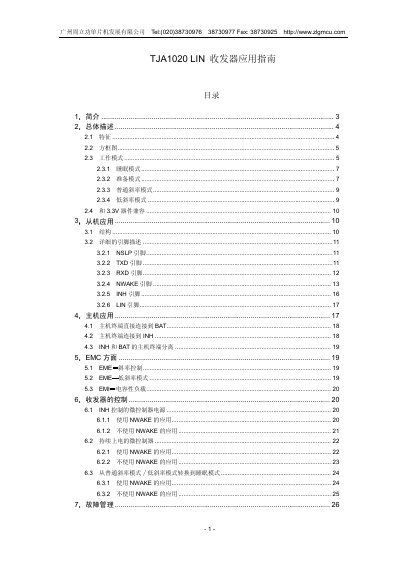
This application guide, published by Guangzhou Zhouligong Microcontroller Development Co., Ltd. (ZLG), explains how to use the TJA1020 LIN transceiver as the physical medium attachment between a LIN host or slave protocol controller and the LIN bus. It describes the LIN protocol basics, the transceiver's four operating modes (normal slope, low slope, standby and sleep), the pin functions, and typical host application connections.
The document also covers slope control and EME/EMI considerations, control of the transceiver with and without the NWAKE pin, transitions back to sleep mode, fault management such as LIN short to ground and TXD dominant faults, minimum baud rate limits, and a comparison with ordinary LIN transceivers in terms of sleep-mode current consumption. This manual is written in Chinese.
| Maximum LIN baud rate | 20 kBaud |
|---|---|
| Maximum nodes in network | 16 |
| Battery operating range | 5 V (voltage drop) to 27 V (jump start) |
| Low slope mode used for | low-speed applications below 10 kBaud |
| Control input compatibility | 3.3 V and 5 V devices |
| Internal slave termination in standby mode | 30 kΩ |
It is intended for LIN transmission rates up to 20 kBaud, with up to 16 nodes in the network.
It has four operating modes: normal slope mode, low slope mode, standby mode and sleep mode.
A remote wake-up produces a weak pull-down on TXD, while a local wake-up produces a strong pull-down on TXD; RXD goes low to flag standby mode.
The transceiver itself draws very little current and the INH output switches off the external voltage regulator, leaving the INH pin floating.