
This document is an application guide for TJA1041 CAN high-speed transceiver from Guangzhou ZLG MCU Development Co., Ltd. It describes the features and characteristics of the product.
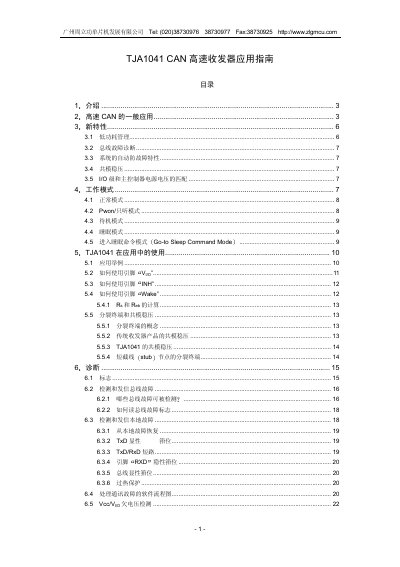
The TJA1041 is a high‑speed CAN transceiver designed for automotive electronic control units. It provides a physical link between a CAN controller and the bus, supporting the ISO 11898 and SAE J2284 standards.
The document covers new features such as low‑power management (down to ~20 µA), voltage‑level adaptation for 2.5 V‑5 V I/O, bus‑fault detection, and various operating modes (Normal, PWON/Listen‑only, Standby, Sleep). It also includes application examples, interoperability with other transceivers, and detailed electrical specifications. This manual is written in Chinese.
| Static current consumption (low‑power mode) | ≈20 µA typical |
|---|---|
| Supply voltage (VCC) | +5 V |
| Package | SO14 |
| Differential input voltage range (dominant state) | 2.5 V – 3.5 V |
| Differential input voltage range (recessive state) | -1.0 V – 0.9 V |
| Maximum average VCC current (no fault) | 47 mA |
It provides five modes: Normal, PWON/Listen‑only, Standby, Sleep and a Go‑to‑Sleep command mode.
The static current can be reduced to about 20 µA typical.