
The Dell PowerEdge R730xd is a server powered by the Intel Xeon E5-2695 v3 processor. It has powerful computing and storage flexibility to meet the needs of various applications and datasets.
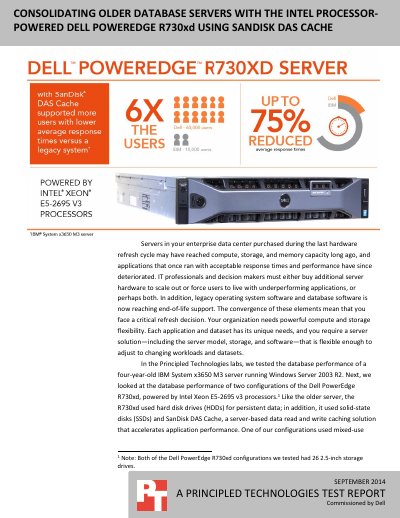
This document is a test report commissioned by Dell that compares the performance of the Dell PowerEdge R730xd server against a legacy IBM System x3650 M3 server. The study focuses on database performance, specifically using SQL Server 2014 and SanDisk DAS Cache technology to accelerate I/O operations.
The report details two configurations of the R730xd: one using SATA SSDs and another using PCIe SSDs for caching. Results indicate that the R730xd could replace six legacy servers, supporting 60,000 concurrent users compared to the legacy server's 10,000, while significantly reducing response times.
| Processor | Intel Xeon E5-2695 v3 |
|---|---|
| Memory | up to 24 DDR4 DIMMs |
| Storage Drives | 26 2.5-inch drives |
| Cache Capacity | 400GB SSD capacity |
A single Dell PowerEdge R730xd can replace six legacy IBM System x3650 M3 servers.
Using PCIe SSDs decreased latency by as much as 75 percent compared to the legacy server.