
This document is a manual for Siemens fuse systems. It introduces the features and advantages of Siemens fuse systems.
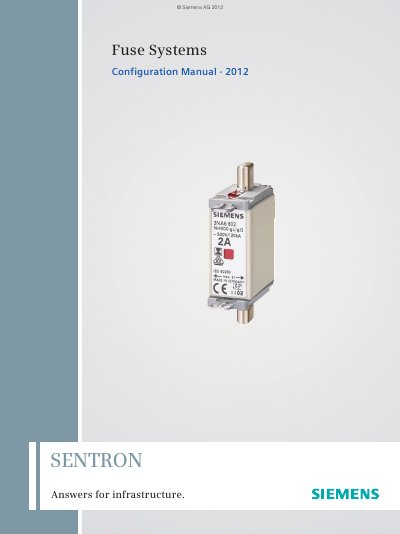
This document is the Siemens Fuse Systems Configuration Manual, published in 2012. It serves as a comprehensive guide for selecting and configuring different types of fuse systems used in non-residential buildings, residential buildings, and industrial applications. The manual covers a wide range of products designed for line protection, switching device protection, and specific applications like photovoltaic systems.
| Rated breaking capacity (NEOZED/DIAZED) | 50 kA |
|---|---|
| Rated breaking capacity (NH fuse systems) | 120 kA |
| Rated breaking capacity (SITOR fuses) | 50 to 100 kA |
| Rated voltage (PV cylindrical fuses) | 1000 V DC |
| Rated current (PV cumulative fuses) | 63 A to 400 A |
Full range fuses (gG, gR, quick, slow) break current during non-permissible overload and short-circuit, while partial range fuses (aM, aR) exclusively serve short-circuit protection.
NEOZED fuse systems comply with IEC 60269-3 and DIN VDE 0636-3 standards.