
PR electronics 3117 series bipolar isolated transmitters are tested to the most stringent safety standards to provide the safest possible signal. The series offers excellent performance and immunity to electromagnetic interference, and can be mounted horizontally or vertically with no gap between devices.
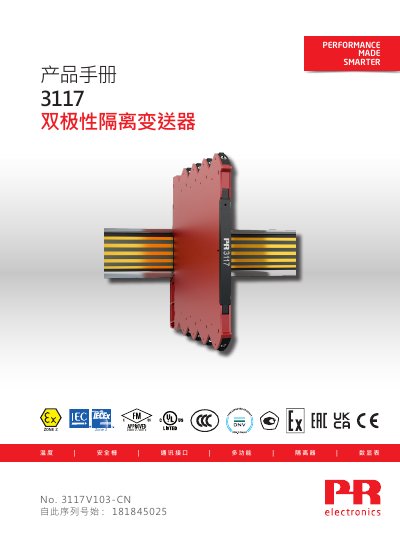
PR electronics 3117 is a bipolar isolated transmitter that converts standard bipolar analog process signals into unipolar analog signals. The manual covers safety precautions, installation and removal, flexible 24 VDC power options, connections, specifications, programming, and operation and troubleshooting.
The device provides three-port electrical isolation, overvoltage and reverse-polarity protection on all terminals, and can be installed in safe areas or Zone 2 and Class I Division 2 areas. Factory-calibrated measurement ranges are configured with DIP switches. This manual is written in Chinese.
| Power supply | 24 VDC (±30%) |
|---|---|
| Conversion accuracy | Better than 0.05% of selected range |
| Electrical isolation | 2.5 kVAC |
| Response time | < 7 ms |
| Signal-to-noise ratio | > 60 dB |
| Operating temperature | -25 to +70°C |
| Housing width | 6.1 mm |
| DIN rail capacity | Up to 163 devices per meter |
| Altitude | At least 2000 m |
| Pollution degree | 2 or better |
| Isolation | 3-port |
| EMC | NAMUR NE21 |
| Terminal protection | Overvoltage and reverse polarity protection |
| Marking area | 5 x 7.5 mm |
It converts standard bipolar analog process signals into unipolar analog signals.
Factory-calibrated measurement ranges are configured with DIP switches.
It uses a flexible 24 VDC (±30%) supply via a power rail or connector.
It can be installed in safe areas or Zone 2 and Class I Division 2 areas.