
This document describes how ICPMS-2030 is used for elemental analysis of packaging material extracts.
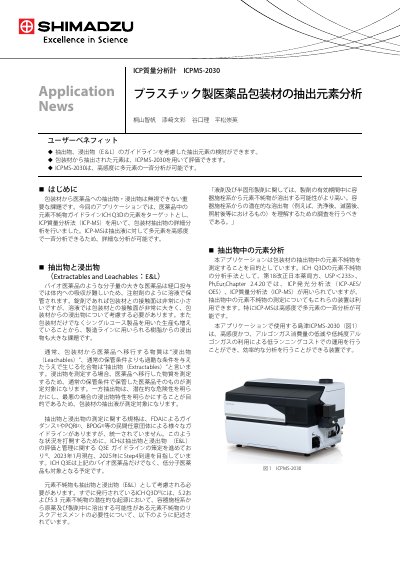
This document describes an application of the Shimadzu ICPMS-2030 for analyzing elemental impurities in extracts from packaging materials used in pharmaceuticals. The analysis targets elements specified in the ICH Q3D guidelines to assess potential risks of leaching and extraction from materials like PVC, PE, and EVA into liquid formulations.
The study utilized three types of infusion bags (PVC, PE, EVA) and various extraction solvents (pH 2.5, pH 9.5, 50% IPA) to simulate different storage conditions. The Shimadzu ICPMS-2030 was configured with specific parameters, including a mini-torch, helium collision gas, and internal standard addition, to achieve high-sensitivity multi-element analysis. Results showed that the instrument's detection limits were sufficient to measure elements against their Permitted Daily Exposure (PDE) values. This manual is written in Japanese.
The extracted elements were evaluated with the Shimadzu ICPMS-2030, which can perform highly sensitive simultaneous multi-element analysis.
Three common infusion bag materials were tested: PVC (DEHP-free), polyethylene (PE), and ethylene-vinyl acetate copolymer resin (EVA).
Cut samples of about 100 cm2 were placed in DigiTubes with 30 mL of extraction solvent and heated at 70 °C for 24 hours, with processing done at n=6.
The analysis targeted the 24 elements specified in ICH Q3D Class 1 through 3, plus Fe and Zn, measured simultaneously by the calibration curve method.