
The present invention provides a method and system for testing oil-water capillary pressure curves of dense cores, comprising: a magnet, a gradient coil, a sample moving platform, a nuclear magnetic resonance radio frequency coil, a nuclear magnetic resonance spectrometer, a radio frequency power amplifier, a gradient amplifier, a power supply, a water cooling machine, a computer including a host and a display, and a preamplifier; the gradient coil is equipped with a water cooling system; by designing a pure phase encoding pulse sequence with a shorter echo time, the fast decaying signal in the dense core is collected, and the fluid saturation distribution when the oil and water phases coexist in the dense core is obtained in combination with a centrifugal device, which is used to test the oil-water capillary pressure curve of the dense core and is more suitable for use at oilfield development sites.
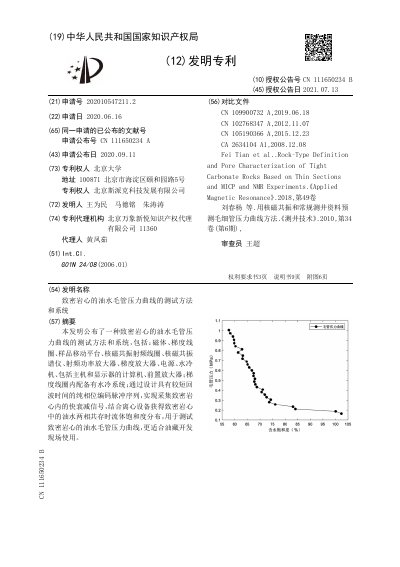
This Chinese invention patent (application CN 111650234 A, granted as CN 111650234 B on 2021-07-13) describes a method for testing oil-water capillary pressure curves of dense cores. The method uses a pure phase encoding pulse sequence with a short echo time to acquire fast-decay NMR signals from tight core samples, and combines this with centrifugal equipment to obtain fluid saturation distributions when oil and water coexist in the core.
The patent also describes an NMR pure phase encoding test system composed of a magnet, gradient coils with a water-cooling system, a sample moving platform, an NMR radio-frequency coil, an NMR spectrometer, an RF power amplifier, a gradient amplifier, a power supply, a water chiller, a computer with host and monitor, and a preamplifier. The claims cover core cleaning and drying, helium porosity measurement, saturation with simulated formation water, instrument initialization with a standard core, oil-drive centrifugation, conversion of saturation distributions, capillary pressure calculation and curve plotting. This manual is written in Chinese.
| Gradient amplifier maximum output current | 150 A |
|---|---|
| Gradient amplifier fastest rise time | 60 μs |
| Magnet structure | U-shaped |
| Magnet uniform region | 300 mm long × 250 mm diameter cylinder |
| Magnet uniformity | ≤30 ppm |
| Gradient field at 150 A | ≥130 mT/m |
| RF power amplifier frequency range | 1 MHz–350 MHz |
| RF power amplifier maximum power | 350 W |
| Preamplifier gain | ≥30 dB |
| Preamplifier noise figure | ≤0.1 dB |
It uses a pure phase encoding sequence designated α-SPI, with a small-angle hard pulse excitation and stepped phase encoding.
The method combines centrifugal equipment with the NMR measurement to obtain the fluid saturation distribution when oil and water coexist in the dense core.
Water saturation at different positions is used as the horizontal axis and the corresponding capillary pressure as the vertical axis.
A standard core sample is used to initialize and debug the nuclear magnetic resonance equipment.