
NDB1LE-63GQ series leakage with over and under voltage circuit breakers are suitable for low-voltage terminal distribution in industrial, civil buildings, energy, communications and infrastructure.
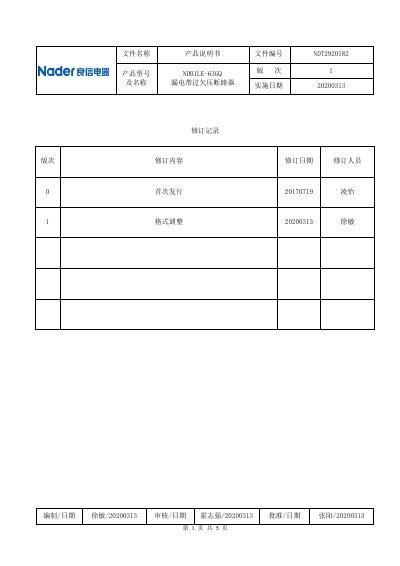
This is the Chinese product manual (document number NDT2920182, edition 1, dated 20200313) for the NDB1LE-63GQ series leakage circuit breaker with over and under voltage protection. It states that the breaker provides short-circuit, overload, leakage, over/under voltage and isolation protection for low-voltage terminal distribution in industrial, civil building, energy, communications and infrastructure applications.
The manual explains the model designation and lists technical parameters, operating environment, wiring diagrams, outline and mounting dimensions, TH35mm rail mounting, accessories such as auxiliary and alarm contacts, operation of the handle and reset button, test-button checks, precautions and ordering information. This manual is written in Chinese.
| Frequency | 50/60 Hz |
|---|---|
| Rated operating voltage | AC230V/240V (2P), AC400V/415V (4P) |
| Rated impulse withstand voltage | 4 kV |
| Rated insulation voltage | 500 V |
| Rated residual operating current | 30 mA |
| Rated short-circuit breaking capacity | 6 kA |
| Mechanical life | 20000 operations |
| Electrical life | 10000 operations |
| Overvoltage trip value | 280V ±12V |
| Undervoltage trip value | 170V ±7V |
| Degree of protection | IP20 on the breaker body; IP40 when installed in a distribution box |
| Ambient temperature | -25°C to +60°C |
| Terminal wire capacity | 1~25 mm² |
| Standard tightening torque | 2.0 N.m |
It is rated for AC230V/240V in the 2-pole version and AC400V/415V in the 4-pole version, at 50/60 Hz.
Perform a simulated leakage test once a month by pressing the test button T; the breaker should trip automatically.
The modular breaker is mounted vertically on a standard TH35mm×7.5 rail, with the top as the incoming terminal and the bottom as the outgoing terminal.
If it tripped due to leakage or over/under voltage, the reset indicator button pops out and must be pressed down before the breaker is closed again.