
KEVLAR® aramid fiber is a kind of organic fiber in the aromatic polyamide family developed by DuPont, with unique high strength, high modulus, high toughness and thermal stability. It is widely used in many industries.
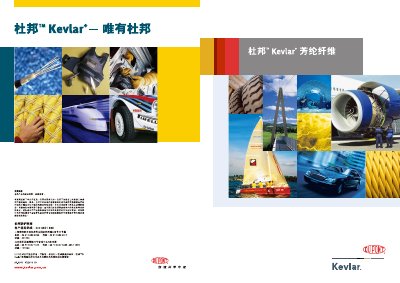
This Chinese-language technical guide from DuPont introduces KEVLAR® aramid fiber, an organic fiber in the aromatic polyamide family. It explains how DuPont scientists developed the polymer in the mid-1960s, the commercial launch of the fiber under the KEVLAR® name in 1971, and the amended FDA food-additive regulations that allow many KEVLAR® products to be used in repeated food contact. The guide states that it covers technical information on KEVLAR® industrial yarn plus basic information on KEVLAR® short fibers.
The main body lists typical properties of KEVLAR® 29 and KEVLAR® 49 yarns in a comparison table, with tensile, thermal and other data given in both US and international units, and notes that the values are representative rather than product specifications. Further chapters describe the effect of chemicals, water, pH, hydrolysis, moisture regain, heat and cold, flammability and smoke, electron radiation and ultraviolet light, and introduce KEVLAR® pulp, cut staple fiber, short fiber, fluff and Engineered Elastomer, followed by a glossary and ordering information. This manual is written in Chinese.
| Density | 0.052 lb/in3 (1.44 g/cm3) |
|---|---|
| Breaking strength (Kevlar 29 / Kevlar 49) | 76.0 lb (338 N) / 59.3 lb (264 N) |
| Tensile modulus (Kevlar 29 / Kevlar 49) | 555 g/d (4,900 cN/tex) / 885 g/d (7,810 cN/tex) |
| Elongation at break (Kevlar 29 / Kevlar 49) | 3.6% / 2.4% |
| Specific heat at 77 °F (25 °C) | 0.34 cal/g·°C (1,420 J/kg·K) |
| Degradation temperature in air | 800-900 °F (427-482 °C) |
| Recommended maximum long-term service temperature in air | 300-350 °F (149-177 °C) |
| Heat of combustion | 15,000 BTU/lb (35x106 Joule/kg) |
| Poisson's ratio | 0.36 |
| Fiber diameter | 0.00047 in (12 micrometers) |
| Moisture content as shipped (Kevlar 29 / Kevlar 49) | 7.0% / 3.5% |
DuPont KEVLAR® is an organic fiber in the aromatic polyamide (aramid) family. Its combination of high strength, high modulus, high toughness and thermal stability distinguishes it from other commercial man-made fibers.
DuPont developed a poly-p-phenylene terephthalamide fiber from its liquid-crystal spinning process, and it was commercialized under the KEVLAR® name in 1971.
The guide states that FDA regulations covering food additives were amended so that many types of KEVLAR® products can be used safely as articles or components of articles for repeated food contact. It advises contacting your DuPont sales representative to find out which specific KEVLAR® products the FDA regulations cover.
No. The table values are typical, commonly seen data for representative deniers and types and are not product specifications; different deniers and product types have different properties.